Real Apps Built by Vibe Coders: 6 That Actually Shipped (2026)
Key takeaways
- These vibe coded apps all shipped to real users, starting with fly.pieter.com reaching a $1M annual run-rate in 17 days
- The viral headline: fly.pieter.com reached a $1M annual run-rate in 17 days, built in roughly three hours with Cursor (@levelsio, founder-reported).
- The non-developer case: Sabrine Matos, a growth marketer who writes no code, built the safety app Plinq on Lovable in 45 days and reached $456K ARR with 10,000+ users (Lovable, 2025).
- Different jobs use different tools: viral games lean on Cursor, no-code apps lean on Lovable, and smaller utilities mix Claude, GPT and Copilot (Indie Hackers, 2026).
- The platforms underneath are real businesses: Lovable crossed $100M ARR in eight months and Cursor passed $2B ARR by early 2026 (TechCrunch).
- The honest part: these are outliers, and viral revenue is volatile, so treat the numbers as proof it is possible, not as the average.
- The pattern that repeats is a narrow problem, a fast first launch and real distribution, not a clever codebase.
Vibe coding gets dismissed as a toy, so it is worth looking at what people have actually shipped with it.
This page collects real vibe-coded apps, who built them, which tool they used, and the numbers they have reported.
Some figures are well documented and some are founder-reported, and we label which is which, because the honest version is more useful to you than the hype.
1 Vibe coded apps, the viral headline: fly.pieter.com
The most-cited vibe-coded app is a browser flight sim that one person built in an afternoon and turned into a $1 million run-rate inside three weeks.
Pieter Levels built fly.pieter.com in about three hours on 22 February 2025, using the AI editor Cursor along with Grok 3, Claude 3.7 Sonnet and the ThreeJS graphics library.
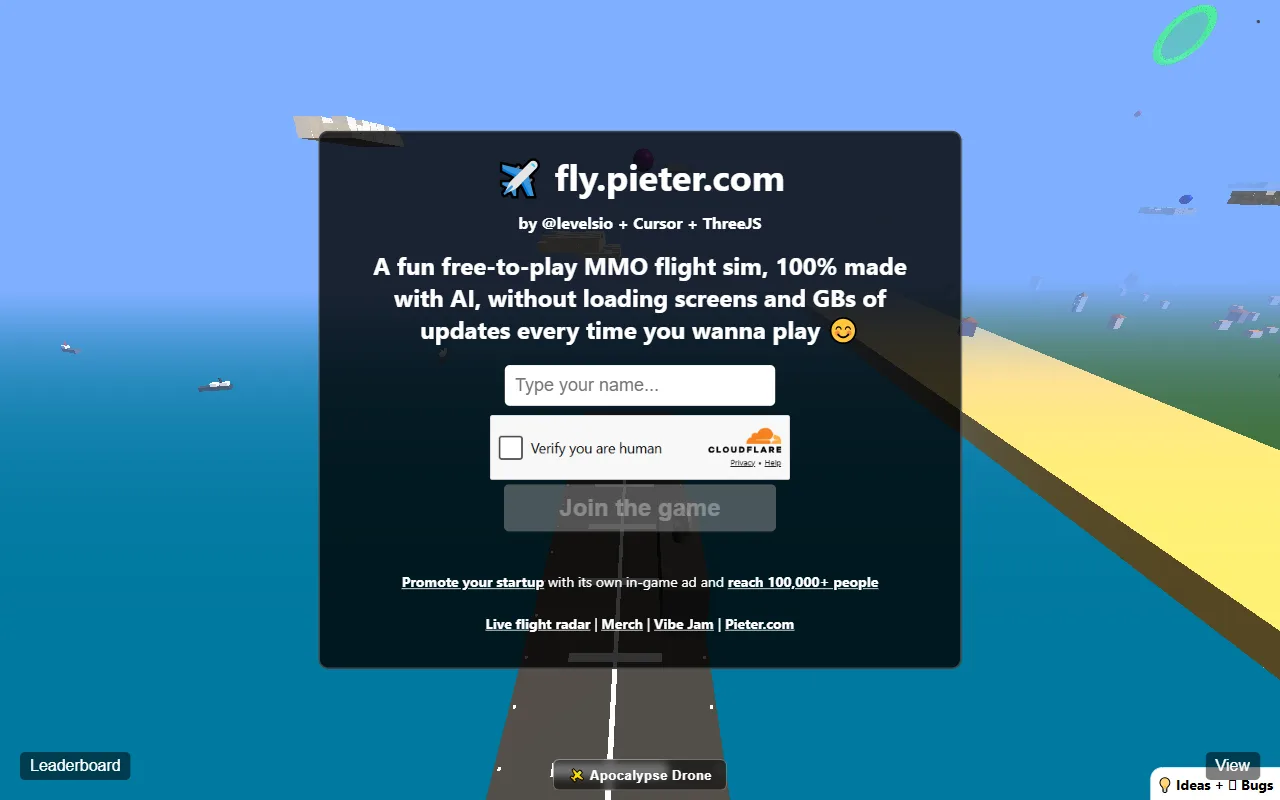
Within 17 days the founder reported it had gone from $0 to roughly $87,000 in monthly recurring revenue, which is a $1 million annual run-rate, with more than 320,000 people having flown in it.
The money did not come from charging players, but from selling in-game sponsorships: brands paid to place objects and logos inside the world.
The honest footnote is that this kind of revenue is volatile, and a viral game’s income tends to fall once the novelty fades, which is exactly what happened here after the peak.
It proves what is possible in a weekend, not what you should expect every weekend.
2 The non-developer breakout: Plinq
If fly.pieter.com is the developer’s viral hit, Plinq is the non-developer’s proof, because the founder wrote no code at all.
Sabrine Matos spent her career in growth marketing and had no engineering background when she built Plinq, a women’s safety app, entirely on Lovable.
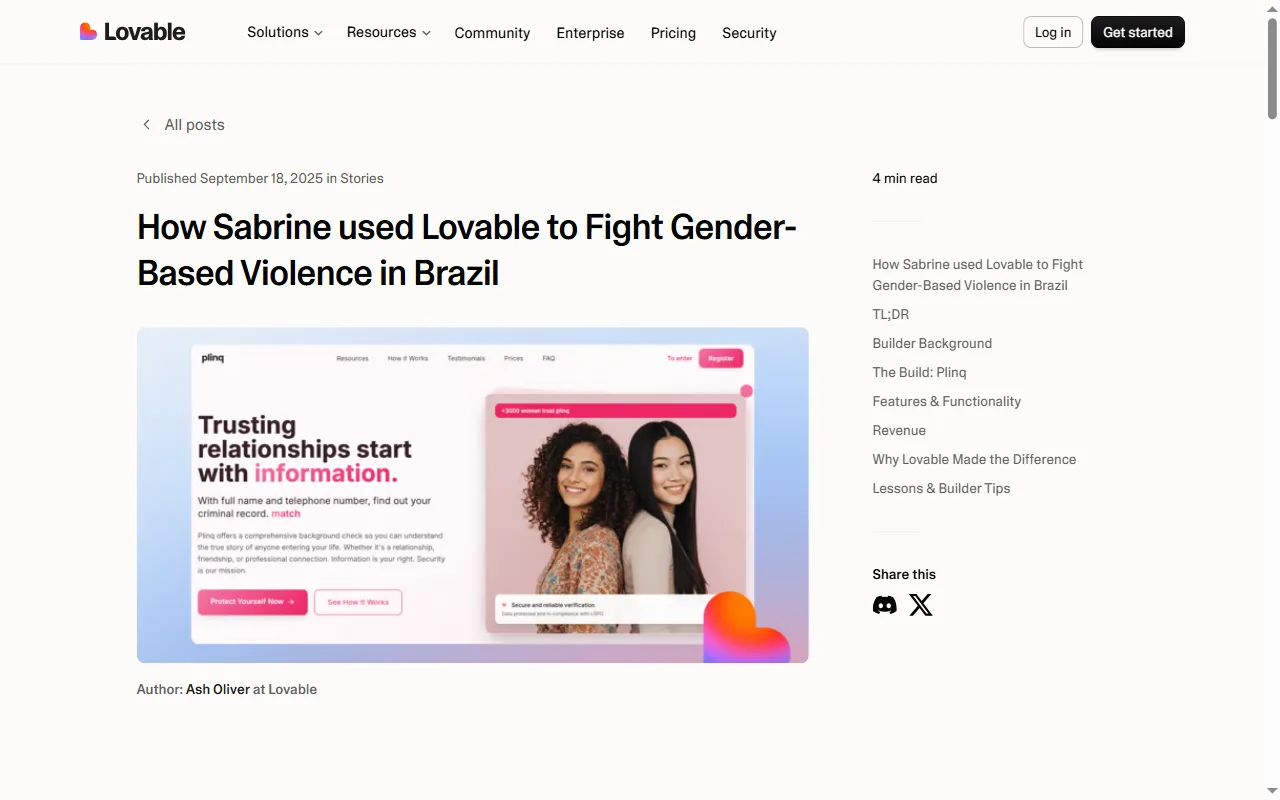
Plinq runs instant criminal-record checks from public databases, adds risk scoring, and includes a panic button that sends a location to emergency contacts.
She shipped the first version in 45 days, and within three months it had passed 10,000 users and roughly $456,000 in annual recurring revenue.
In her own words she built the website, the app and the backend workflows without an engineering degree, which is the single clearest example on this page of a non-developer shipping a paying product.
It is also the most useful template for our readers, because the path was a real problem, a no-code tool and steady distribution, not a technical breakthrough.
3 The full roster of shipped apps
Here is the wider set of vibe-coded apps with real, named builders, the tool each used, and the outcome each has reported.
| App | Builder | Tool used | Reported outcome | Reported by |
|---|---|---|---|---|
| fly.pieter.com | Pieter Levels | Cursor | $1M ARR run-rate, 320K+ players | Founder (@levelsio) |
| Plinq | Sabrine Matos | Lovable (no code) | $456K ARR, 10K+ users | Lovable case study |
| TrendFeed | Sebastian Volkis | Claude + GPT | $10K MRR in month one | Indie Hackers |
| Vibe Sail | Nicola Manzini | GitHub Copilot | ~$8K/mo (~$96K/yr) | Indie Hackers |
| ChatIQ | Sebastian Volkis | Claude + GPT | $2K MRR, 11K+ users | Indie Hackers |
| Illustration.app | Evan (22) | AI-assisted build | $1.7K/mo, 8K users | Indie Hustle |
The pattern in the right-hand column matters: the two best-documented cases sit at the top, and the rest are founder-reported single sources, which is why they are labelled rather than presented as audited figures.
Read the smaller numbers as a realistic floor for a focused tool with a clear audience, and the top two as the rare breakout.
4 What the ones that shipped have in common
Across every example, the win came from the same three things, and none of them is the code.

First, each app solved one narrow problem rather than trying to be a platform, which is what made it buildable by a small team or a single person.
Second, the builders shipped a rough first version fast, then improved it in public, instead of polishing in private for months.
Third, distribution did the heavy lifting: a viral post, an existing audience, or a real-world problem people already searched for.
The tool mattered, but mostly as a fit for the job, which is the decision worth getting right before you start.
If you are not sure which tool suits what you want to build, our vibe coding tool finder quiz matches you to one in five questions, and our comparison of which AI coding tool actually ships products weighs them side by side.
Before you bank on the headline numbers, it is worth reading what the success-rate data for non-developers actually shows, because the apps on this page are the exception, not the rule.
Building something similar? See which path fits
Pick what you want to build and we will point to the matching tool and the app on this page that proves it.
Methodology
This page only lists apps with a named, real builder and a public source, and it labels how each figure was reported.
- Apps included: 6, each with a named builder and a cited source
- Best documented: fly.pieter.com (founder’s public revenue updates, widely reported) and Plinq (Lovable’s published case study)
- Labelled as founder-reported: TrendFeed, Vibe Sail, ChatIQ and Illustration.app, drawn from Indie Hackers and Indie Hustle
- Excluded: apps with no named builder, and extraordinary single-source launch claims that could not be corroborated
- Data range: 2025 to 2026
- Last verified: 19 June 2026
- Note: revenue figures move and viral income is volatile, so check the linked sources for the current position
Frequently asked questions
What are some real apps built with vibe coding?
The most-cited is fly.pieter.com, a browser flight sim Pieter Levels built in about three hours with Cursor that reached a $1 million annual run-rate.
The clearest non-developer example is Plinq, a women’s safety app a growth marketer built on Lovable with no code, reaching $456,000 ARR and 10,000+ users.
Can you really make money from a vibe-coded app?
Yes, and the apps on this page have, but the numbers range widely from a few thousand a month to a $1 million run-rate.
Treat the big figures as proof it is possible rather than the average, because viral revenue is volatile and most apps earn far less.
Which tools were used to build these apps?
Viral games and interactive builds leaned on Cursor, while the no-code app Plinq was built entirely on Lovable.
The smaller tools mixed Claude, GPT and GitHub Copilot, so the right choice depends on the job, which our tool comparison breaks down.
Did a non-developer actually build one of these?
Yes, Sabrine Matos built Plinq with no engineering background, doing the website, app and backend workflows entirely on Lovable.
It is the strongest example here that you do not need to code to ship a paying product.
How long did these apps take to build?
The first playable version of fly.pieter.com took roughly three hours, while Plinq’s first version took about 45 days.
A rough, shippable first version was fast in every case, but turning it into a product people pay for took ongoing work.
Are these typical results for vibe coders?
No, they are outliers, which is why they made the news in the first place.
For a grounded picture of what most non-developers actually achieve, see our breakdown of the vibe coding success rate.
Sources & references
- Pieter Levels (@levelsio). “fly.pieter.com revenue update: $0 to $1M ARR in 17 days.” X, 2025. x.com/levelsio. Accessed 19 June 2026.
- Lovable. “How Sabrine used Lovable to Fight Gender-Based Violence in Brazil.” 18 September 2025. lovable.dev. Accessed 19 June 2026.
- TechCrunch. “Vibe-coding startup Lovable raises $330M at a $6.6B valuation.” 18 December 2025. techcrunch.com. Accessed 19 June 2026.
- TechCrunch. “Eight months in, Swedish unicorn Lovable crosses the $100M ARR milestone.” 23 July 2025. techcrunch.com. Accessed 19 June 2026.
- Tech Insider. “Cursor AI Valuation and Anysphere’s $2B Revenue (2026).” tech-insider.org. Accessed 19 June 2026.
- Indie Hackers. “Vibe coding examples: revenue-generating apps built with AI.” indiehackers.com. Accessed 19 June 2026.
- Indie Hackers. “How 5 vibe-coded AI games went viral.” indiehackers.com. Accessed 19 June 2026.
- Indie Hustle. “Dropped out of college to build an AI illustration app.” indiehustle.co. Accessed 19 June 2026.
- EverydayAI. “5 Vibe Coded Apps Making Real Money.” everydayaiblog.com. Accessed 19 June 2026.