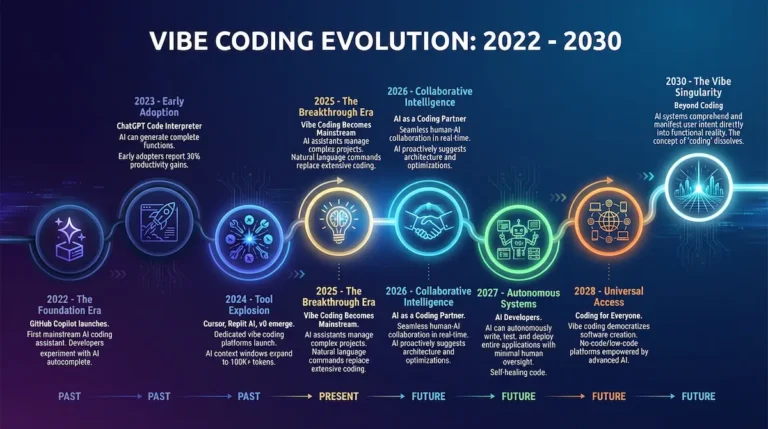
Vibe Coding Glossary of Terms
A
Accept/Reject — Interface option in vibe coding platforms that allows developers to selectively approve or decline AI-suggested code changes, maintaining code quality while leveraging AI assistance.
Ablation — A technique for evaluating feature importance by temporarily removing a component from a model and retraining to observe performance changes, helping identify critical system elements.
Abductive Logic Programming (ALP) — A high-level knowledge-representation framework enabling problem-solving through abductive reasoning by allowing predicates to be incompletely defined.
Abductive Reasoning — A form of logical inference starting with observations to find the simplest and most likely explanation, yielding plausible conclusions without positive verification.
Abstraction — The process of removing physical, spatial, or temporal details from objects or systems to focus on other aspects of interest.
Activation Functions — Mathematical functions enabling neural networks to learn nonlinear relationships between features and labels, including ReLU, sigmoid, and tanh.
Active Learning — A training approach where algorithms selectively choose which data to learn from, valuable when labeled examples are scarce or expensive.
AdaGrad (Adaptive Gradient Algorithm) — A sophisticated gradient descent algorithm that rescales gradients for each parameter, effectively providing independent learning rates.
Agent — In reinforcement learning, the entity using a policy to maximize expected return; in modern AI, software that reasons about multimodal inputs to plan and execute actions.
Agent Mode — Advanced feature in tools like Cursor and Windsurf where AI actively searches and understands entire codebases for context-aware assistance.
Agentic AI — AI systems designed to autonomously pursue complex goals and workflows with limited direct human supervision, breaking tasks into steps and adapting based on outcomes.
Agentic Workflow — A dynamic process where an agent autonomously plans and executes actions to achieve goals, involving reasoning, invoking external tools, and self-correction.
AI Observability — The capability to monitor, understand, and trace AI system behavior, outputs, and decision-making processes.
AI Slop — Output from generative AI systems favoring quantity over quality, such as low-quality, cheaply produced AI-generated content.
Alignment — The extent to which an AI’s goals are in line with its creators’ goals, ensuring safe and beneficial AI behavior.
AlphaGo — An AI system developed by Google DeepMind that plays the board game Go, becoming the first computer program to beat human professionals.
ANFIS (Adaptive Neuro Fuzzy Inference System) — An artificial neural network combining neural networks and fuzzy logic principles to capture benefits of both frameworks.
Anomaly Detection — The process of identifying outliers or unusual patterns in datasets that deviate significantly from normal behavior.
Anthropomorphism — Attribution of human traits, emotions, or characteristics to non-human entities like AI systems.
API (Application Programming Interface) — A set of protocols and tools defining how software applications interact, essential for integrating AI tools in development workflows.
Approximation Error — The discrepancy between exact values and their approximations in machine learning models.
Artificial General Intelligence (AGI) — A type of AI that matches or surpasses human cognitive capabilities across a wide range of tasks, capable of broad problem-solving and creativity.
Artificial Intelligence (AI) — Any intelligence demonstrated by machines, contrasting with natural intelligence in humans and animals, including both narrow and general AI systems.
Artificial Neural Network — Computer systems designed to mimic brain structures, composed of interconnected nodes organized in layers for processing information.
Attention Mechanism — A neural network mechanism indicating the importance of particular words or parts, compressing information needed to predict next tokens in transformers.
Attribute — A quality or characteristic describing an observation, such as color or size, equivalent to feature in machine learning contexts.
Auto-Encoder — A neural network system learning to extract important information through compression, consisting of an encoder and decoder component.
Automated Machine Learning (AutoML) — Automated processes for building ML models, including hyperparameter tuning, feature engineering, and model deployment.
Autonomous Agents — AI systems capable of operating independently to pursue goals, make decisions, and interact with environments with minimal human supervision.
Autoregressive Model — A model inferring predictions based on its own previous predictions, as seen in transformer-based language models.
AUC (Area Under the ROC Curve) — A metric between 0.0 and 1.0 representing binary classification models’ ability to separate positive from negative classes.
B
Backpropagation — The algorithm implementing gradient descent in neural networks, calculating and propagating error gradients backward through layers to update weights.
Bagging (Bootstrap Aggregating) — A machine learning ensemble technique training multiple models on random subsets of data to improve stability and accuracy.
Bag-of-Words Model — A simplifying representation disregarding grammar and word order but keeping word multiplicity, used in NLP and information retrieval.
Baseline — A reference model for comparing how well another model performs, helping quantify minimal expected performance for new approaches.
Base Model — A pre-trained model serving as a starting point for fine-tuning to address specific tasks or applications.
Batch — The set of examples used in one training iteration, with batch size determining the number of examples processed.
Batch Inference — Processing predictions on multiple unlabeled examples divided into smaller subsets, leveraging accelerator chip parallelization.
Batch Normalization — Normalizing input or output of activation functions in hidden layers to stabilize training and reduce overfitting.
Batch Size — The number of examples processed in a single training iteration, typically ranging from 1 (SGD) to thousands (full batch).
Bayesian Neural Network — A probabilistic neural network accounting for uncertainty in weights and outputs, predicting distributions rather than point estimates.
Bayesian Optimization — A probabilistic technique optimizing expensive objective functions using surrogate models that quantify uncertainty.
Behavior Tree (BT) — A mathematical model for plan execution describing switchings between finite task sets in modular fashion, popular in robotics and game development.
Bellman Equation — In reinforcement learning, an identity satisfied by optimal Q-functions, fundamental to Q-learning algorithms.
BERT (Bidirectional Encoder Representations from Transformers) — A model architecture using transformers and self-attention for text representation, bidirectional context processing, and unsupervised training.
Bias (Ethics/Fairness) — Stereotyping, prejudice, or favoritism toward certain groups, affecting data collection, system design, and user interaction.
Bias (Math) or Bias Term — An intercept or offset in machine learning models, allowing patterns not passing through origin points.
Bidirectional Language Model — A language model determining token probability based on both preceding and following context text.
Binary Classification — A classification task predicting one of two mutually exclusive classes, such as spam/not spam or disease/no disease.
Binary Condition — In decision trees, a condition with only two possible outcomes, typically yes/no answers.
Binning (Bucketing) — Converting continuous features into multiple binary features representing value ranges, enabling models to learn separate relationships per bucket.
Black Box Model — A model whose reasoning is impossible or difficult for humans to understand, lacking interpretability despite functional outputs.
BLEU (Bilingual Evaluation Understudy) — A metric between 0.0 and 1.0 evaluating machine translations by comparing N-gram overlap between generated and reference text.
BLEURT — A metric for evaluating machine translations, particularly to/from English, emphasizing semantic similarities and accommodating paraphrasing.
Boolean Questions (BoolQ) — A dataset evaluating LLM proficiency in answering yes/no questions grounded in Wikipedia passages.
Boosting — A machine learning technique iteratively combining weak classifiers into strong classifiers by upweighting misclassified examples.
Bounding Box — In image processing, the (x,y) coordinates of a rectangle around areas of interest for object detection.
Broadcasting — Expanding operand shapes in matrix operations to compatible dimensions for computation.
Bolt.new — A visual-first vibe coding platform optimized for rapid frontend development with live previews and one-click deploys.
C
Calibration Curve — A visualization technique evaluating predicted probability calibration for classification models.
Capsule Neural Network (CapsNet) — A machine learning system better modeling hierarchical relationships by mimicking biological neural organization.
Case-Based Reasoning (CBR) — Solving new problems based on solutions of similar past problems, leveraging case similarity.
Causal Language Modeling (CLM) — Language modeling predicting next tokens based on preceding context, used in models like GPT.
Chain-of-Thought (CoT) Prompting — A prompt engineering technique encouraging LLMs to explain reasoning step-by-step, improving accuracy for complex tasks.
Chatbot — A computer program conducting conversations via auditory or textual methods, simulating human dialogue.
Chatbot Hallucination — The tendency of AI chatbots to confidently present false information as factual.
Claude — An advanced AI model by Anthropic widely used in vibe coding for deep code understanding and detailed explanations.
Class Imbalance — Imbalanced class distributions in datasets, challenging for standard accuracy metrics.
Classification — Predicting categorical outputs, including binary classification (two classes) and multi-class classification (multiple classes).
Classification Threshold — The lowest probability value at which positive classification is asserted, determining decision boundaries.
Clustering — Unsupervised grouping of data into buckets where similar observations cluster together.
Clustering Algorithms — Methods like k-means and hierarchical clustering for discovering natural data groupings.
Cloud Robotics — Field combining cloud computing with robotics, enabling robots to access powerful computational resources remotely.
Code Interpreter — AI capability executing code based on natural language instructions, essential for AI-assisted development.
Commonsense Knowledge — Facts about everyday world that humans expect to know, challenging for AI systems to acquire.
Commonsense Reasoning — AI branch simulating human ability to make presumptions about ordinary situations.
Computational Complexity Theory — Field classifying problems by inherent difficulty and relating complexity classes.
Computational Creativity — Multidisciplinary endeavor using AI in creative domains including arts and music.
Computer Vision — Field enabling computers to gain high-level understanding from digital images and videos.
Confusion Matrix — Table describing classification model performance, grouping predictions into true positives, true negatives, false positives, and false negatives.
Context Window — The maximum length of text an LLM can process in a single operation, limiting input/output size.
Continuous Integration Model — Automated processes for integrating code changes and maintaining model quality.
Continuous Variables — Features with value ranges defined by number scales, such as price or temperature.
Convergence — A training state reached when model changes become minimal between iterations.
Convolutional Neural Network (CNN) — A deep learning architecture class most commonly applied to image analysis.
Corrective RAG — Retrieval-Augmented Generation variant that corrects and refines retrieved information for improved accuracy.
Cross-Lingual Language Models — Models understanding and generating text across multiple languages.
Cross-Validation — Evaluation technique dividing data into subsets, training multiple models, and averaging performance metrics.
Crossover — In genetic algorithms, a genetic operator combining genetic information from two parents to generate offspring.
Cursor — Popular AI-powered code editor combining VS Code familiarity with advanced AI capabilities, supporting multiple models.
D
Data Augmentation — Techniques increasing dataset size through transformations, helping reduce overfitting when training algorithms.
Data Binning — Organizing data into discrete intervals or buckets for analysis.
Data Cleaning — Preprocessing step removing errors, inconsistencies, and irrelevant information from datasets.
Data Decomposition — Breaking complex data into simpler, interpretable components.
Data Flywheel — Self-reinforcing mechanism where improved outputs generate better training data for further improvements.
Data Granularity — The level of detail at which data is organized and analyzed.
Data Integration — Combining data from different sources into unified views for analysis.
Data Mining — Process discovering patterns in large datasets using machine learning, statistics, and databases.
Data Science — Interdisciplinary field extracting knowledge from data using scientific methods, statistics, and computing.
Dataset — Collection of data, typically organized as database tables or statistical matrices with rows representing instances.
Data Warehouse — Centralized repository of integrated data from disparate sources, supporting reporting and analysis.
Data-Centric AI — Approach prioritizing data quality and organization over model complexity for AI system improvements.
Decision Boundary — The surface separating different predicted classes in classification models.
Decision Intelligence — Field combining AI and business analytics for improved decision-making.
Decision Tree — Tree-structured model with nodes representing conditions and branches representing decision paths.
Deep Blue — AI system developed by IBM that defeated world chess champion Garry Kasparov.
Deep Belief Networks — Probabilistic models composed of stacked restricted Boltzmann machines for unsupervised learning.
Deep Learning — Machine learning approach using neural networks with multiple layers to learn hierarchical data representations.
Deep Q-Network (DQN) — Reinforcement learning algorithm combining Q-learning with deep neural networks for complex control tasks.
Deep Reinforcement Learning — Combining reinforcement learning with deep neural networks for agent training on complex tasks.
DeepEval — Framework for evaluating large language models and AI systems.
DenseNet — Deep learning architecture using dense connections between layers for improved gradient flow.
Density-Based Clustering — Clustering algorithms grouping observations by density, such as DBSCAN.
Diffusion Models — Generative models trained to reverse diffusion noise addition processes, producing diverse outputs.
Dimensionality Reduction — Techniques reducing feature number while preserving essential information, including PCA and t-SNE.
Direct Preference Optimization (DPO) — Fine-tuning method aligning LLM outputs with human preferences without reward model training.
Dotfiles — Configuration files customizing vibe coding tools and development environments, often shared among developers.
E
Embeddings (LLM Embeddings) — Dense vector representations of text capturing semantic meaning, enabling similarity comparisons.
Encoder — In neural networks, the component compressing inputs into lower-dimensional representations.
Emergence/Emergent Behavior — Complex behavior arising from simple component interactions without explicit programming.
ELIZA — Early chatbot developed in 1960s simulating psychotherapist through pattern matching and substitution.
Ensemble Methods — Machine learning techniques combining multiple models to improve prediction accuracy.
Epoch — Complete pass through entire dataset during training, comprising multiple batches.
Evaluation Metrics — Quantitative measures assessing model performance, including accuracy, precision, recall, and F1-score.
Explainability — The ability to understand and interpret AI model decisions and predictions.
Expo Go — Mobile development platform enabling rapid prototyping and testing of applications using vibe coding principles.
Experimentation Framework — Systems for conducting controlled tests and A/B testing in AI development.
Extrapolation — Making predictions outside training data ranges, often problematic for model generalization.
F
False Negative — Type II error where model incorrectly predicts negative class for positive instance.
False Positive — Type I error where model incorrectly predicts positive class for negative instance.
False Positive Rate (FPR) — Ratio of false positives to total negative instances, forming ROC curve x-axis.
Feature — An attribute-value combination describing observation aspects; in Excel terms, equivalent to cells.
Feature Engineering — Process creating, transforming, and selecting features to improve model performance.
Feature Selection — Identifying relevant features from datasets for ML model creation.
Feature Vector — List of feature values describing observation attributes, equivalent to table rows.
Few-Shot Prompting — Providing one or more solved examples before requesting AI to solve new problems.
Fine-Tuning — Adapting pre-trained models to specific tasks through continued training on task-specific data.
Foundation Model — Large pre-trained models serving as starting points for diverse downstream applications.
Forward Pass — First step in neural network training where data moves through layers producing predictions.
Function Calling — AI capability understanding and executing specific programming functions based on natural language descriptions.
G
Generative AI — AI systems generating new content like text, images, and code based on prompts and training data.
Generative Pre-trained Transformer (GPT) — Type of large language model architecture powering systems like ChatGPT.
GitHub Copilot — AI pair programmer providing real-time code suggestions as developers type, mainstream AI-assisted coding tool.
Gradient Accumulation — Mechanism splitting batches into mini-batches run sequentially to enable larger effective batch sizes.
Gradient Descent — Optimization algorithm iteratively adjusting model parameters to minimize loss functions.
Gradient Boosting — Ensemble technique building models sequentially, each correcting predecessor errors.
Graph Traversal — Algorithm exploring graph structures systematically, used in pathfinding and planning.
Grounding — Connecting LLM outputs to factual information sources to reduce hallucinations.
Guardrails — Safety mechanisms ensuring LLM outputs comply with specified constraints and ethical guidelines.
H
Hallucination — Tendency of AI models to confidently generate false or misleading information as factual.
Hierarchical Clustering — Clustering algorithms creating tree-structured hierarchies of nested clusters.
Hidden Layer — Intermediate neural network layers between input and output layers, enabling nonlinear learning.
Heuristic — Problem-solving strategy trading guaranteed optimal solutions for faster practical results.
Hot Reload — Development feature automatically updating applications in real-time as code changes occur.
Hyperparameter — Higher-level model properties like learning rate and network depth, adjusted before training.
Hyperparameter Tuning — Systematic optimization of hyperparameter values to improve model performance.
I
Inference — Process using trained models to make predictions on new, unseen data.
Integration — Connecting various AI tools and platforms to create cohesive development environments.
Instance — Single data point, row, or sample in dataset, also called observation.
Implicit Bias — Unconscious prejudice affecting decision-making in model design and data interpretation.
Interpretability — Ability to understand and explain AI model decisions and feature importance.
Induction — Bottom-up logical approach going from observations to theories and conclusions.
J
Jupyter — Interactive notebook environment supporting vibe coding through code, documentation, and AI assistance mixing.
Jailbreaking (LLM Jailbreaking) — Techniques attempting to bypass LLM safety mechanisms and guardrails.
K
K-Means — Centroid-based clustering algorithm partitioning data into k clusters by minimizing within-cluster variance.
K-Nearest Neighbors (KNN) — Instance-based learning algorithm classifying instances based on k nearest training examples.
Karpathy, Andrej — AI researcher who coined the term “vibe coding” in early 2025, describing AI-assisted software development.
L
Label — The answer or target value in supervised learning, what models learn to predict.
LangChain — Framework for developing applications with large language models, handling chains of operations.
Large Language Model (LLM) — Neural networks trained on massive text data to understand, generate, and manipulate human language.
Large Action Models — AI systems designed to take complex actions in environments based on understanding and planning.
Lazy AI — Development approach maximizing AI tool usage to minimize manual coding effort while maintaining quality.
Learning Rate — Hyperparameter controlling update step sizes during gradient descent optimization.
Learning-to-Rank — Machine learning approach optimizing ranking of search results or recommendations.
LightGBM — Gradient boosting framework using leaf-wise tree growth for improved efficiency.
LIME (Local Interpretable Model-Agnostic Explanations) — Technique explaining individual model predictions through local approximations.
Linear Regression — Supervised learning algorithm modeling linear relationships between features and continuous targets.
LLM Agents — Autonomous AI systems using LLMs to perform complex tasks and interact with environments.
LLM Alignment — Process ensuring LLM behavior aligns with human values and intentions.
LLM APIs — Application programming interfaces enabling integration of LLMs into applications.
LLM Benchmarks — Standardized evaluation datasets and metrics assessing LLM capabilities.
LLM Cost — Financial and computational expenses associated with training and deploying LLMs.
LLM Deployment — Process preparing and releasing LLMs for production use in applications.
LLM Distillation — Technique training smaller models to mimic larger LLM behavior for efficiency.
LLM Evaluation — Assessing LLM performance through metrics, benchmarks, and human evaluation.
LLM Fine-Tuning — Adapting pre-trained LLMs to specific tasks through continued training.
LLM Hallucinations — False or misleading information confidently generated by LLMs.
LLM Inference — Process using trained LLMs to generate predictions and responses.
LLM Observability — Capability to monitor, understand, and trace LLM behavior and outputs.
LLM Orchestration — Coordinating multiple LLM components and tools in complex workflows.
LLM Parameters — Learnable values in LLM weights, often in billions or trillions.
LLM Playground — Interactive environments for experimenting with LLM prompts and parameters.
LLM Quantization — Reducing model size by lowering precision of parameters for efficiency.
LLM Red Teaming — Adversarial testing attempting to identify vulnerabilities and failure modes.
LLM Sleeper Agents — Hypothetical AI systems with hidden goals activated under specific conditions.
LLM Toxicity — Evaluation of harmful or offensive content potentially generated by LLMs.
LLM Tracing — Monitoring and recording LLM decision processes for debugging and improvement.
LLMOps — Operations and management practices for deploying, monitoring, and maintaining LLM systems.
Llama — Open-source large language model series by Meta.
Logistic Regression — Supervised learning algorithm for binary classification using sigmoid functions.
LSTM (Long Short-Term Memory) — Recurrent neural network variant addressing vanishing gradient problems for sequential data.
Loss Function — Mathematical function measuring prediction error, minimized during training.
M
Machine Learning — Field enabling computers to learn from data without explicit programming.
Machine Learning Algorithm — Methods like regression, decision trees, SVMs, and neural networks for model creation.
Machine Learning Bias — Systematic errors from sampling or reporting procedures affecting fairness.
Machine Learning Inference — Process using trained models for predictions on new data.
Machine Learning Lifecycle — Complete process from data collection through model deployment and monitoring.
Machine Learning Model Accuracy — Percentage of correct predictions made by classification models.
Machine Learning Model Deployment — Process releasing trained models to production environments.
Machine Learning Model Evaluation — Assessing model performance using validation data and metrics.
Machine Learning Pipeline — Sequence of data preprocessing, feature engineering, and model training steps.
Masked Language Models (MLM) — Models predicting masked tokens in text using bidirectional context.
Mean Absolute Error (MAE) — Average absolute differences between predicted and actual values.
Mean Square Error (MSE) — Average squared differences between predictions and targets.
Memory-Augmented Neural Networks — Networks with external memory components for improved reasoning.
Meta-Learning — Learning to learn approach enabling quick adaptation to new tasks.
Micromodels — Smaller specialized models addressing specific tasks or domains.
Mixture of Experts — Neural network architecture using multiple specialized subnetworks.
ML Architecture — Design and structure of machine learning systems and components.
ML Interpretability — Ability to understand and explain ML model decisions.
ML Model Card — Documentation describing model purpose, performance, and limitations.
ML Model Validation — Evaluating model performance on held-out test data.
ML Observability — Monitoring and understanding ML system behavior in production.
ML Orchestration — Coordinating multiple ML workflow components.
MLOps — Operations and engineering practices for productionizing ML systems.
Model Calibration — Adjusting model outputs so predicted probabilities match actual frequencies.
Model Collapse — Phenomenon where models trained on AI-generated data degrade in quality.
Model Distillation — Training smaller models to replicate larger model behavior.
Model Drift — Performance degradation over time due to changing data distributions.
Model Explainability — Techniques for interpreting and explaining model decisions.
Model Fairness — Ensuring ML models don’t discriminate against protected groups.
Model Merging — Combining multiple trained models into single models.
Model Monitoring — Continuously tracking model performance in production.
Model Observability — Capability to monitor, understand, and debug model behavior.
Model Registry — Centralized system managing model versions, metadata, and deployment information.
Model Retraining — Periodically updating models with new data to maintain performance.
Model Robustness — Resistance to adversarial examples and distribution shifts.
Model Selection — Choosing appropriate algorithms and architectures for specific tasks.
Model Tuning — Optimizing hyperparameters and architecture decisions for improved performance.
Model-Based Machine Learning — Approaches explicitly modeling probability distributions for reasoning.
Modular RAG — Retrieval-Augmented Generation variant using independent retrieval and reasoning modules.
Multimodal Model — AI model processing and generating multiple input/output types (text, images, audio, video).
Multilingual LLM — Large language model capable of understanding and generating multiple languages.
Multi-Class Classification — Classification predicting one of multiple possible classes.
N
Natural Language Processing (NLP) — Field enabling machines to understand, interpret, and generate human language.
Neural Network — Mathematical systems modeled on brain architecture with interconnected nodes for pattern recognition.
Neuron — Fundamental processing unit in neural networks, combining weighted inputs through activation functions.
Normalization — Techniques scaling feature values to similar ranges for improved training stability.
Noise — Irrelevant information obscuring underlying patterns in datasets.
Null Accuracy — Baseline accuracy from always predicting most frequent class in imbalanced datasets.
O
Observation — Single data point, row, or sample in dataset, also called instance.
OpenAI — Leading AI research company developing GPT models powering many vibe coding tools.
Optimization — Process adjusting model parameters to minimize loss functions.
Outlier — Data point deviating significantly from other observations in dataset.
Overfitting — Model learning training data too well, incorporating noise specific to dataset, performing poorly on new data.
P
Panoptic Segmentation — Image segmentation approach unified with instance and semantic segmentation.
Parameter — Learnable value in model weights adjusted during training; contrasts with hyperparameter.
Parameter-Efficient Fine-Tuning (PEFT) — Techniques fine-tuning models using minimal trainable parameters.
Pattern Recognition — Identifying recurring structures and relationships in data.
PCA (Principal Component Analysis) — Dimensionality reduction technique finding principal variance directions.
Perplexity — Metric measuring how well language models predict text sequences.
Plagiarism — Unacknowledged use of others’ words or ideas, important concern with AI-generated content.
Pooling Layers — Neural network layers reducing spatial dimensions while preserving important features.
Positional Encoding — Technique enabling transformers to understand token sequence order.
Precision — Metric measuring proportion of positive predictions that are actually correct.
Pre-trained Model — Model trained on large datasets as starting point for fine-tuning on specific tasks.
Prompt — User input to which AI systems respond, including text and multimodal inputs.
Prompt Chaining — Feeding one model’s output as the prompt for subsequent models.
Prompt Engineering — Art and science of crafting effective prompts for optimal AI results.
Prompt Injection — Techniques attempting to manipulate AI systems through specially crafted prompts.
Prompt Injection Testing — Security testing identifying vulnerabilities to prompt-based attacks.
Prompt Management — Systems organizing and versioning prompts for AI applications.
Prompt Playground — Interactive environments for experimenting with prompts and model parameters.
Q
Q-Function — In reinforcement learning, function estimating action value for state-action pairs.
Q-Learning — Reinforcement learning algorithm learning optimal policies through Q-function updates.
Quantization — Reducing numerical precision of model weights to decrease size and computation.
Quick Fix — AI-powered feature suggesting and implementing rapid solutions to coding problems.
R
RAG (Retrieval-Augmented Generation) — Technique combining document retrieval with text generation for improved accuracy and grounding.
RAG Architecture — Design patterns for implementing retrieval and generation components in RAG systems.
RAG Evaluation — Assessing RAG system performance on retrieval, generation, and end-to-end metrics.
Random Forests — Ensemble method combining multiple decision trees trained on data subsets.
Reasoning Engine — System enabling AI to break down problems and derive logical conclusions.
Recall — Metric measuring proportion of actual positive instances correctly identified.
Recall at k — Metric measuring fraction of relevant items found in top k ranked results.
Recurrent Neural Network (RNN) — Neural network architecture processing sequential data through hidden states.
Regression — Predicting continuous numerical outputs, such as prices or temperatures.
Regularization — Techniques combating overfitting by adding complexity penalties to loss functions.
Reinforcement Learning — Training models to maximize rewards through iterative trial and error.
Reinforcement Learning from Human Feedback (RLHF) — Fine-tuning method aligning model outputs with human preferences through reward models.
Replit — Cloud-based development environment supporting vibe coding through integrated AI features.
ResNet — Deep learning architecture using residual connections for improved gradient flow in very deep networks.
Retrieval-Augmented Generation — Technique connecting language models to external knowledge sources.
Ridge Regression — Linear regression with L2 regularization preventing overfitting.
ROC (Receiver Operating Characteristic) Curve — Plot evaluating classification model performance at various thresholds.
S
Sampling — Selecting subset of data from larger population for analysis.
Schema — Structured representation of data organization and relationships.
Scikit-Learn — Popular Python machine learning library for algorithms and preprocessing.
Self-Attention — Transformer mechanism letting each token attend to others, enabling context understanding.
Self-Consistency CoT — Chain-of-thought variant generating multiple reasoning paths and selecting most frequent answer.
Semantic Router — System routing requests based on semantic meaning rather than keywords.
Semi-Supervised Learning — Training using both labeled and unlabeled data to improve model performance.
Sentiment Analysis — Task classifying text into sentiment categories like positive, negative, or neutral.
Seq2Seq Model — Sequence-to-sequence architecture encoding input sequences and decoding output sequences.
Shadow Deployment — Deploying new models alongside production models for comparison without user exposure.
Shapley Values — Game-theoretic approach calculating feature contribution to predictions.
Sigmoid Function — Activation function producing outputs between 0 and 1, commonly used in binary classification.
Softmax Function — Activation function converting logits to probability distributions across multiple classes.
Supabase — Open-source Firebase alternative working well with vibe coding tools for backend development.
Supervised Learning — Training models on labeled datasets with known input-output pairs.
Support Vector Machine (SVM) — Algorithm finding optimal hyperplanes separating different classes in high-dimensional spaces.
Surrogate Model — Simpler model approximating complex model behavior for interpretability or efficiency.
Synthetic Data — Artificially generated data mimicking real data distributions for training or testing.
T
TensorFlow — Open-source machine learning framework by Google for building and training models.
Test Set — Dataset portion reserved for final model evaluation, assessing generalization.
Text-to-Audio Generation — Creating audio content from textual descriptions.
Text-to-Code Generation — Creating programming code from textual descriptions.
Text-to-Design Generation — Creating visual design elements from textual descriptions.
Text-to-Face Generation — Creating realistic facial images from textual descriptions.
Text-to-Game Content Generation — Creating video game content from textual descriptions.
Text-to-Image Generation — Creating images from textual descriptions, powering systems like DALL-E and Midjourney.
Text-to-3D Model Generation — Creating three-dimensional objects from textual descriptions.
Text-to-Video Generation — Creating video content from textual descriptions.
Time to First Token — Latency metric measuring time until first output token generation, important for interactive systems.
Token — Fundamental unit of text processed by language models, including words and subwords.
Tokenization — Process breaking text into tokens for language model processing.
Top-1 Error Rate — Metric measuring classification accuracy when model’s top prediction is wrong.
Training Data — Dataset used to train AI models through optimization.
Training Set — Dataset portion used for model training and parameter optimization.
Transfer Learning — Reusing pre-trained model weights as starting point for new tasks.
Transformer — Neural network architecture using self-attention mechanisms for parallel processing, foundation of modern LLMs.
Tree-Based Models — Models using tree structures for decision-making, including decision trees and random forests.
Tree-of-Thought — Advanced prompting technique exploring multiple reasoning paths hierarchically.
True Negative — Correct prediction of negative class, important metric in classification.
True Positive — Correct prediction of positive class.
True Positive Rate (TPR) — Sensitivity metric measuring proportion of positive instances correctly identified.
Type 1 Error — False positive error incorrectly predicting positive class.
Type 2 Error — False negative error incorrectly predicting negative class.
TypeScript — Typed JavaScript superset well-suited for vibe coding due to strong type system.
U
Underfitting — Model over-generalizing, failing to capture relevant data variations, performing poorly on training and test sets.
Unidirectional Language Model — Language model evaluating only preceding text context for predictions.
Unit Testing — Testing approach enhanced by AI, with tools automatically generating and maintaining test cases.
Universal Approximation Theorem — Neural networks with one hidden layer can approximate any continuous function within input range.
Unsupervised Learning — Training models finding patterns in unlabeled data, including clustering.
V
Validation Set — Dataset portion used during training for feedback on generalization, detecting overfitting.
Vanishing Gradient Problem — Training issue where gradients become too small in deep networks, impeding learning.
Variance — Metric measuring prediction consistency; high variance suggests overfitting.
Variational Autoencoder (VAE) — Autoencoder variant using probabilistic encoding for generative modeling.
Vercel — Deployment platform offering seamless vibe coding integration, particularly for frontend applications.
Vibe Coding — AI-driven programming approach where software is created from natural language descriptions, enabling rapid development without extensive traditional coding skills.
Vibe-Driven Development (VDD) — Methodology prioritizing team harmony, creative expression, and user emotional connection over rigid processes.
W
Weight — Parameter in neural networks determining feature importance, adjusted during training.
Windsurf — AI-powered development platform combining code generation with project management features for vibe coding workflows.
X
Xcode — Apple’s IDE integrating AI features for iOS development supporting vibe coding practices.
Y
Zero-Shot Learning — AI capability understanding and generating code without specific training examples, fundamental to vibe coding tools.
Zero-Shot Chain-of-Thought — Prompting AI to generate logical reasoning without provided examples.
Z
YAML — Configuration format commonly used in vibe coding for defining AI tool settings and project configurations.