
What Is an AI Wrapper? A Plain-English Guide for Vibe Coders (2026)
Key takeaways
- What is an AI wrapper: an app that takes your input, adds instructions and context, calls an existing model’s API, and returns a result for one job
- An AI wrapper is an app that takes your input, adds instructions and context, sends it to an existing model’s API, and returns a useful result for one specific job (CRV, 2026).
- Wrappers come in two kinds: thin (a UI on a model) and thick (custom logic, multiple models, tool integrations) (Loganix, 2026).
- The proof a wrapper can be huge: Cursor hit $2B annual recurring revenue in early 2026 (Bloomberg / TechCrunch).
- The cautionary tale: Jasper, valued near $1.5B as a GPT-3 writing tool, saw its value evaporate when ChatGPT launched free (SQ Magazine, 2026).
- A Google VP warned in 2026 that the industry has little patience for products that just white-label a model (TechCrunch, 2026).
- Yes, a non-developer can build one, because wrappers are small and single-purpose; the rule is to build a thick, vertical wrapper, not a thin skin over GPT (industry consensus, 2026).
You have probably heard someone dismiss an AI product as “just a wrapper”.
It is one of the most thrown-around phrases in tech, and one of the least understood.
This guide explains what an AI wrapper actually is in plain English, why some are worth billions while others vanish, and whether you, as a non-developer, can build one worth having.
1 What is an AI wrapper, actually?
An AI wrapper is an app that sits between you and a powerful model, adding the right instructions and context so the model does one specific job well.
You give the wrapper your input, it sends that to a model like Claude or GPT through an API with instructions already in place, and it hands back a result tailored to a single purpose.
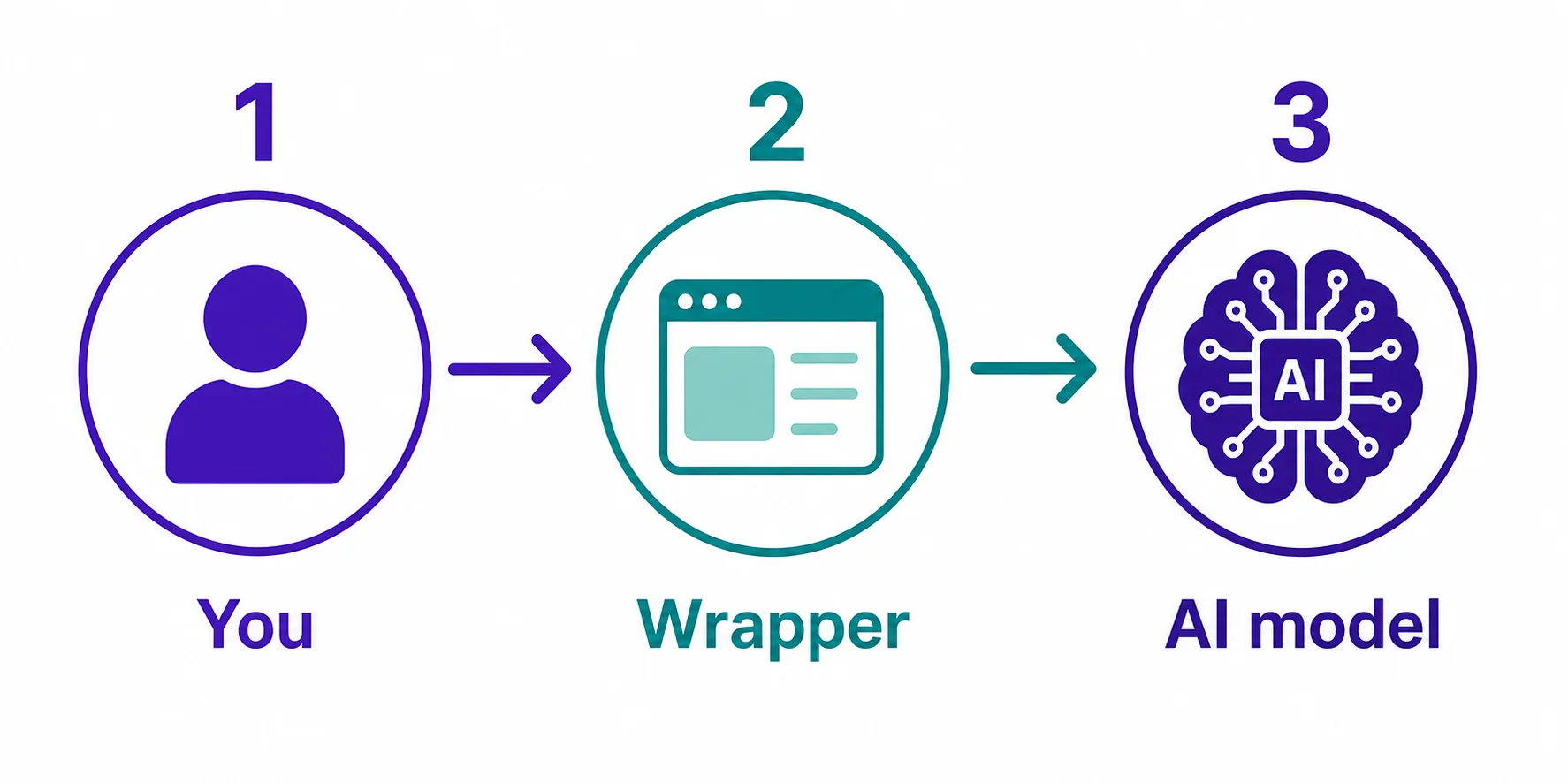
The most familiar example is an app that lets you “chat with a PDF”: you upload a document, ask questions, and a model answers using that document.

Other common types include niche writing assistants and single-purpose vertical tools, all of which lean on a general model underneath.
2 Thin vs thick wrappers
The single most useful distinction is between a thin wrapper and a thick one, because it predicts which survive.
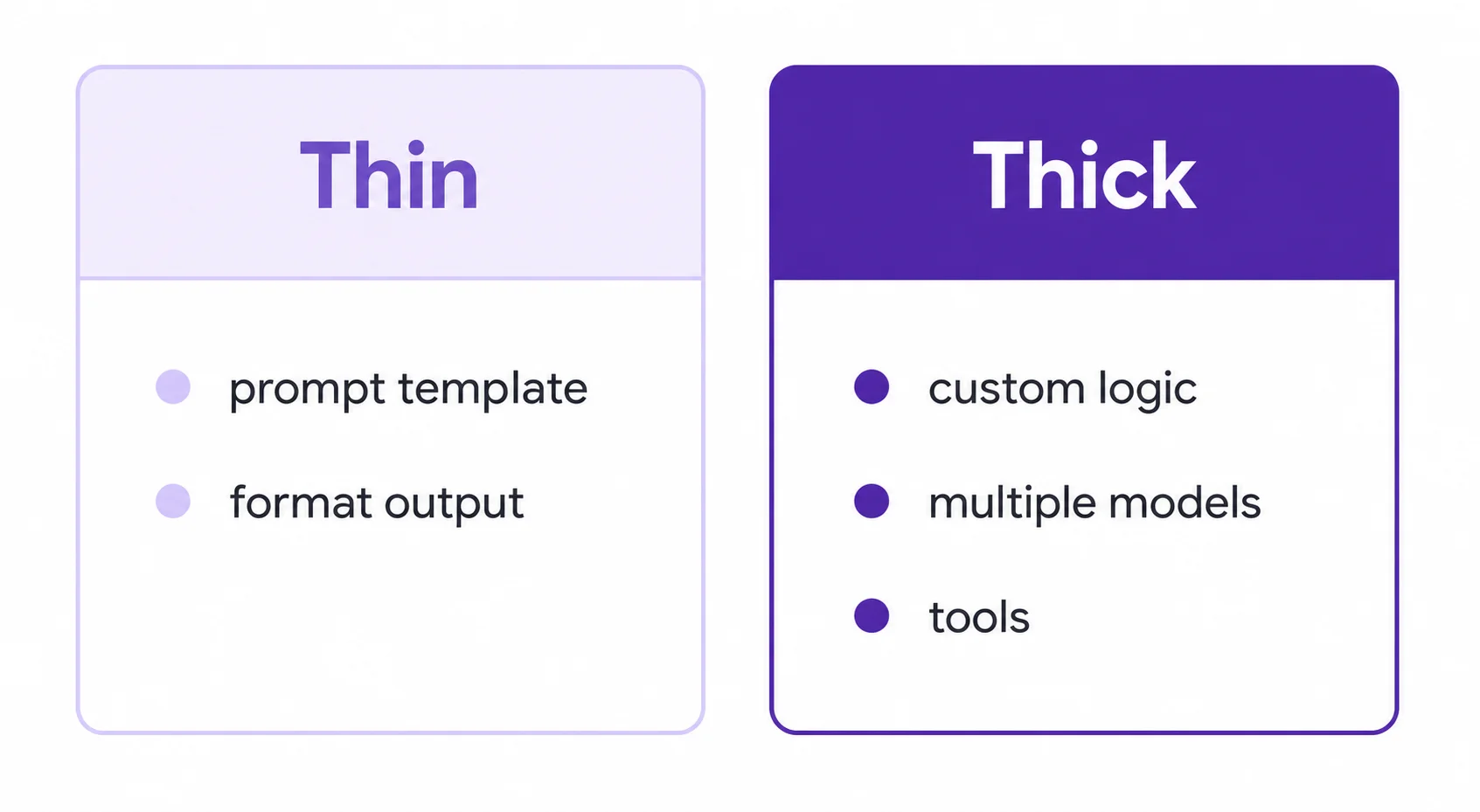
A thin wrapper mainly does prompt templating and tidies the output, which is fast to build but easy to copy.
A thick wrapper adds custom logic, chains several models together, integrates external tools, and makes decisions, which is what creates a moat.
That difference is the whole reason some wrappers thrive and others disappear, which is the next question.
3 “Just a wrapper” or a real business?
Both verdicts are true, depending on the build: thin wrappers are fragile, while thick ones with a real moat are now some of the fastest-growing software companies alive.
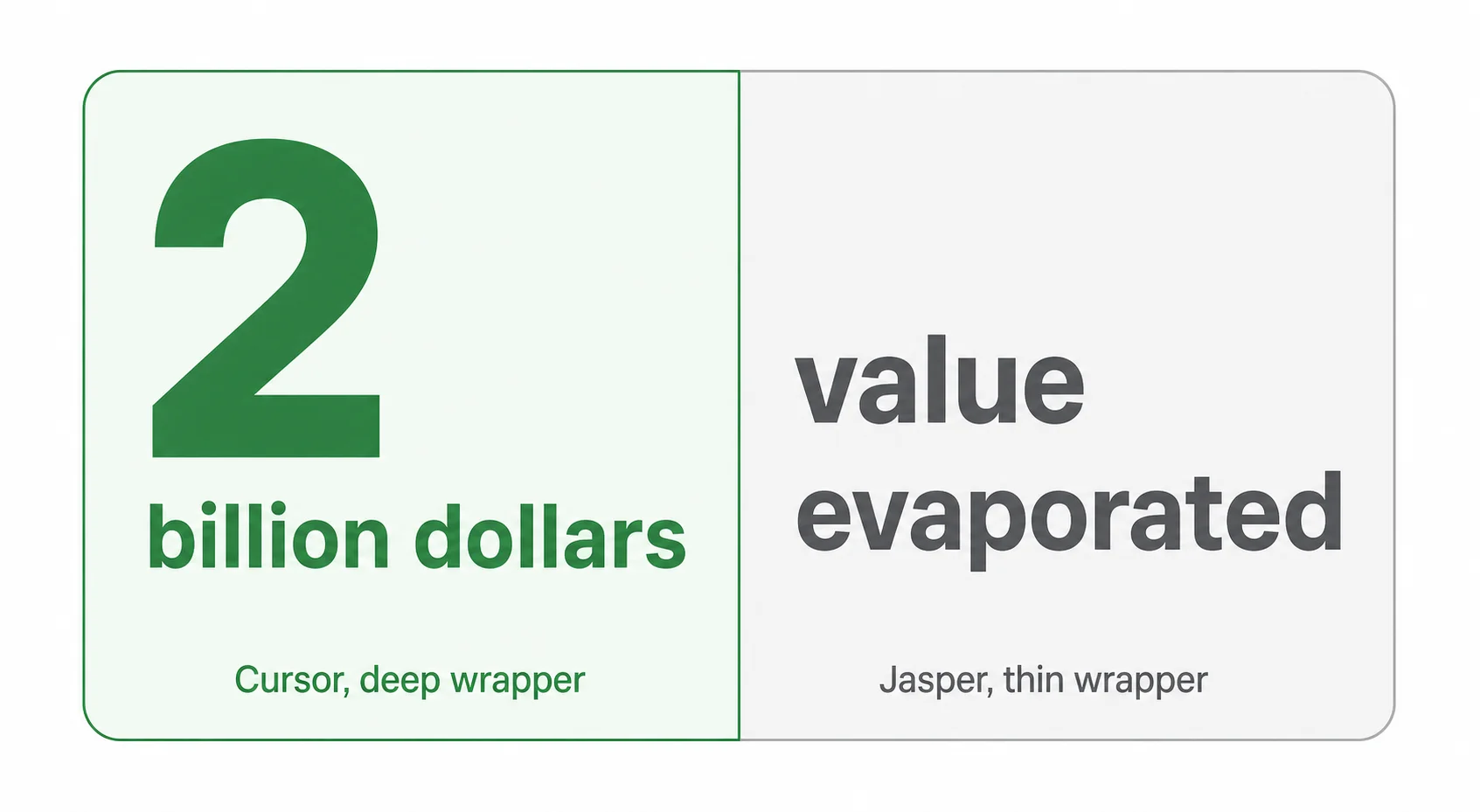
On the success side, Cursor reached $2 billion in annual recurring revenue by early 2026, doubling from $1 billion in just three months, with enterprise customers making up about 60% of revenue.
Its edge is not the interface but fine-tuned models and a data flywheel from millions of users that a newcomer cannot easily copy.
A Google VP leading its startup organisation put the 2026 mood bluntly, warning that if you are almost white-labelling a model, the industry does not have a lot of patience for that anymore.
The rule that separates the two outcomes is a moat: vertical depth, strong UX, workflow integration or network effects, rather than a UI on top of GPT.
If you want to see how that plays out across the popular build tools, our comparison of which AI coding tool actually ships products weighs them on exactly this.
4 Can a non-developer build one?
Yes, and a wrapper is one of the most realistic things to vibe code, as long as you build a thick, vertical one rather than a thin skin.
A wrapper is small and single-purpose, which is why solo builders have shipped them in days, and why a non-developer with the right tool can too.
The catch is defensibility: the same low barrier that lets you build it lets anyone else build it, and the model provider can absorb the feature outright, exactly what happened to the early writing wrappers.
So aim for a specific audience and a real workflow, the kind of thick wrapper that is hard to copy, and pick a build path deliberately.
If you want to build it code-first, our guide to vibe coding with Claude walks through the workflow, and if you are not sure which tool fits, the vibe coding tool finder quiz matches you to one in five questions.
Just keep your expectations honest, because building a wrapper is fast but turning it into something people pay for is not, as our breakdown of what the success-rate data actually shows makes clear.
Thin or thick? A quick gut-check on your idea
Pick the statement that best describes the wrapper you have in mind.
Methodology
This guide draws on reputable 2026 reporting and industry analysis of AI wrappers, including the revenue and valuation figures for Cursor and Jasper.
- Sources consulted: 14 across journalism, VC and industry analysis
- Sources cited: 9, led by TechCrunch reporting and market data
- Data range: 2026
- Last verified: 18 June 2026
- Note: founder-reported indie revenue figures are excluded as unverified; revenue and valuation figures change, so check the linked sources for the current position
Frequently asked questions
What is an AI wrapper, in plain English?
It is an app that sits between you and a powerful AI model.
You give it your input, it adds the right instructions and context, sends that to a model like Claude or GPT through an API, and hands you back a useful result for one specific job.
Is an AI wrapper a real business, or “just a wrapper”?
Both are true depending on the build.
Thin wrappers that just put a UI on a model are risky, but deep wrappers with a real moat thrive: Cursor reached $2 billion in annual recurring revenue by early 2026.
Can a non-developer actually build an AI wrapper?
Yes, because a wrapper is small and single-purpose, and solo builders have shipped them in days.
The catch is to build a thick, vertical wrapper that solves a real workflow, not a thin skin over GPT, and you can see the build tools in our tool comparison.
What is the difference between a thin and a thick wrapper?
A thin wrapper mainly does prompt templating and tidies the output.
A thick wrapper adds custom logic, chains several models, integrates external tools and makes decisions, which is what creates defensibility.
What is the biggest risk of building an AI wrapper?
That the model provider ships your feature natively and wipes out your edge.
Jasper, once valued at about $1.5 billion, saw its core value evaporate when ChatGPT launched free, the classic warning for thin wrappers.
What are examples of successful AI wrappers?
Cursor for coding, Harvey for legal work, and the app builders Bolt and Lovable are all deep wrappers built on other companies’ models.
Their edge is vertical depth, UX and workflow integration, not the underlying model.
Sources & references
- CRV. “What is an AI Wrapper? What Gets Funded + Examples.” crv.com. Accessed 18 June 2026.
- Loganix. “What is an AI Wrapper?” loganix.com. Accessed 18 June 2026.
- TechCrunch. “Google VP warns that two types of AI startups may not survive.” 2026-02-21. techcrunch.com. Accessed 18 June 2026.
- Tech Insider. “Cursor AI Valuation Hits $60B: Anysphere’s $2B Revenue Surge (2026).” tech-insider.org. Accessed 18 June 2026.
- DigitalApplied. “Cursor AI Hits $2B Revenue.” digitalapplied.com. Accessed 18 June 2026.
- SQ Magazine. “Jasper AI Statistics 2026.” sqmagazine.co.uk. Accessed 18 June 2026.
- The VC Edge. “Playing Devil’s Advocate on AI Wrappers.” thevcedge.substack.com. Accessed 18 June 2026.
- Pakodas. “How Deep Wrappers Are Dominating GenAI.” pakodas.substack.com. Accessed 18 June 2026.
- DEV (Kacper). “How to build an AI wrapper in 1 day.” dev.to. Accessed 18 June 2026.