Claude Code vs Cursor (2026): An Honest, Fact-Checked Comparison
Key Takeaways
- → Claude Code vs Cursor changed shape when Cursor’s parent Anysphere was acquired by SpaceX for $60bn all-stock on 16 June 2026
- → Cursor’s parent Anysphere was acquired by SpaceX for $60bn all-stock on 16 June 2026, expected to close in Q3 pending regulatory approval (CNBC, Forbes)
- → The Claude Code repository has around 137,000 GitHub stars against Cursor’s 33,000, though Cursor’s public repo is only a closed-source issues shell (GitHub)
- → Cursor has a free Hobby tier, while Claude Code has no free plan and starts at $20 per month (cursor.com, claude.com)
- → Claude Code runs a 1 million token context window on Opus 4.6 with no surcharge, generally available since 13 March 2026 (Anthropic)
- → One widely cited test measured Claude Code using around 5.5x fewer tokens than Cursor, but it was a single task and a single model pairing (Ian Nuttall test)
- → Cursor is used by roughly 64% of the Fortune 500 and reached an estimated $4bn annualised revenue in 2026 (industry reporting)
Claude Code and Cursor are the two names every non-developer keeps hearing in 2026.
One is a terminal agent from Anthropic that you hand a task and let run.
The other is a code editor that keeps you in the driver’s seat with AI on tap.
This is an honest, fact-checked head-to-head, and where the popular talking points are shakier than they sound, we say so plainly.
If you want the broader field first, our comparison of the best AI coding tools for non-developers covers all eight contenders.
1 The $60bn plot twist that reset the comparison
On 16 June 2026 SpaceX agreed to acquire Cursor’s parent company Anysphere for $60 billion in stock, the largest acquisition of a venture-backed startup ever recorded. The deal is expected to close in Q3 2026 subject to regulatory approval, so it is agreed but not yet final.
| Metric | Value | Source |
|---|---|---|
| Deal value | $60bn | CNBC |
| Structure | All-stock | CNBC |
| Announced | 16 Jun 2026 | Forbes |
| Expected close | Q3 2026 (pending) | CNBC |
| Acquirer | SpaceX / xAI | TechFundingNews |
Why does an acquisition matter to someone just trying to build an app?
Because Cursor’s entire pitch was neutrality: pick whichever model you like, from whichever lab.
Deal reporting says Cursor usage data will now feed xAI’s Grok training pipeline, which is exactly the independence that made Cursor attractive to cautious teams.
Within days, one r/cursor thread claiming a spike in “Cursor alternatives” searches drew 166 upvotes, though that particular claim rests on a single Google Trends screenshot and is not independently confirmed.
The takeaway is not panic, it is context: Cursor still offers the widest model choice of any tool here, but the ownership question is now part of the decision.
2 Claude Code vs Cursor at a glance
Neither tool is universally better because they solve different problems. Claude Code optimises for execution depth, meaning you delegate a whole task and let the agent explore, edit and test. Cursor optimises for editor velocity, meaning you stay hands-on with inline edits and your choice of model.
| Dimension | Claude Code | Cursor |
|---|---|---|
| What it is | Terminal agent | AI code editor |
| GitHub stars | 137,000 | 33,000 (shell repo) |
| Context window | 1M (Opus 4.6) | ~70-120K reported |
| Models | Claude only | Multi-model |
| Free tier | None | Free Hobby tier |
| Best for | Long autonomous runs | Visual, hands-on editing |

The star gap looks dramatic, and it is worth understanding honestly.
Cursor is closed-source, so its public getcursor/cursor repository is really an issues-and-releases shell, which means 137,000 versus 33,000 reflects repository popularity rather than the size or quality of either codebase.
Cursor is itself built as a wrapper around VS Code with AI layered on top, which is why it feels instantly familiar to anyone who has used Microsoft’s editor.
Claude Code, by contrast, lives in your terminal and also plugs into VS Code, JetBrains, the desktop app and the web, so the two overlap more than the “editor versus terminal” framing suggests.
3 Pricing: what each actually costs
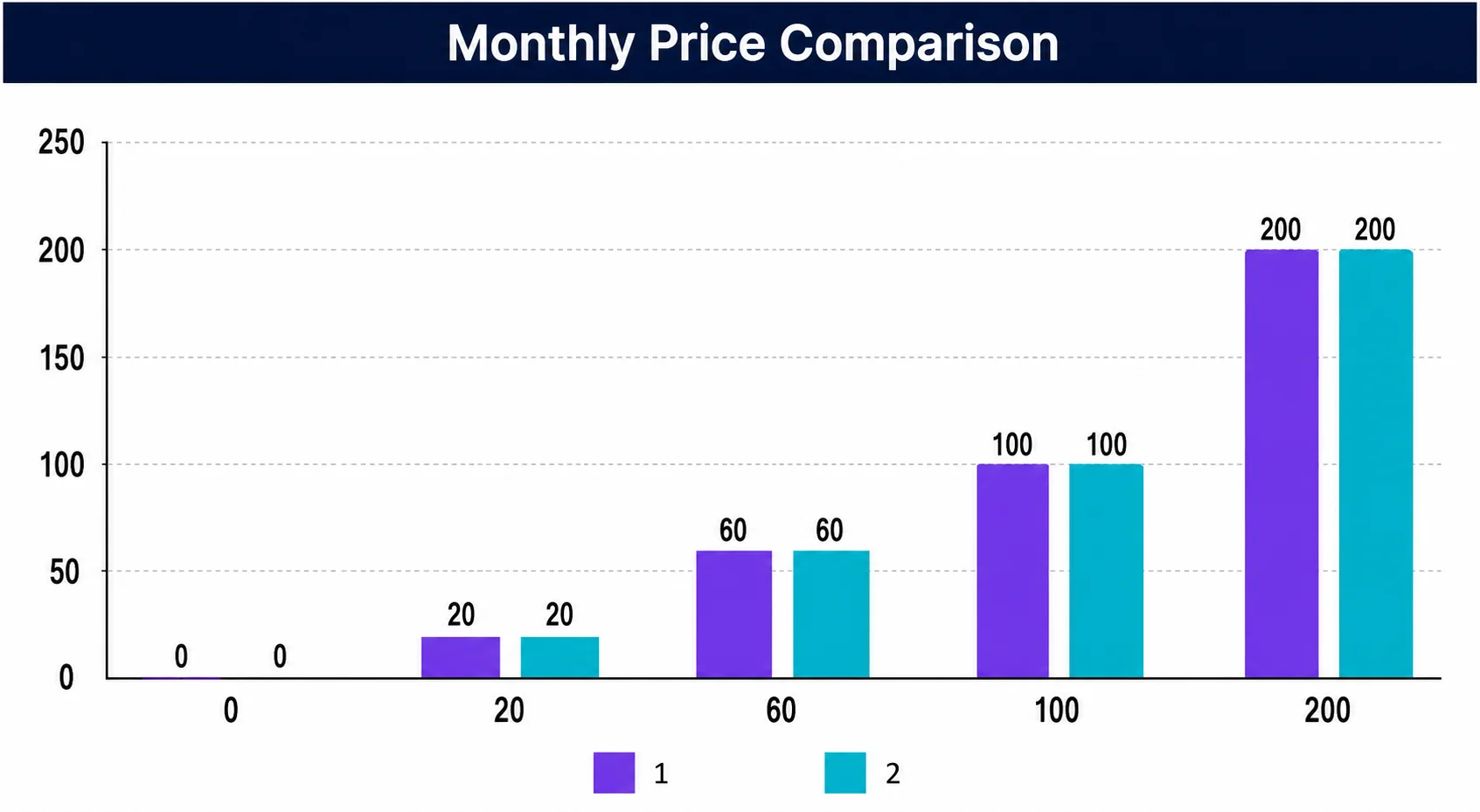
Cursor is cheaper to start because it has a free Hobby tier, while Claude Code has no free plan and begins at $20 per month. At the top end both reach $200 per month, so the real difference is at the entry point and in how many tokens your work burns.
| Tier | Claude Code | Cursor |
|---|---|---|
| Free | None | Hobby (free) |
| Entry | Pro $20/mo | Pro $20/mo |
| Mid | Max 5x $100/mo | Pro+ $60/mo |
| Top | Max 20x $200/mo | Ultra $200/mo |
| Team | $100/seat | from $40/seat |
For a non-developer testing the water, the free Hobby tier is Cursor’s single biggest practical advantage.
You can try it without a card before committing a penny, whereas Claude Code asks for at least $20 up front.
Cursor’s team pricing carries a caveat worth flagging: the public page lists teams from $40 per seat, but a June 2026 pricing change also introduced a higher premium seat, so team buyers should check the current page rather than trust a single quoted figure.
Usage cost matters as much as the sticker price, and heavy sessions can move fast, which is one reason people track Claude’s usage limits so closely.
4 The “5.5x fewer tokens” claim, fact-checked
You will see “Claude Code uses 5.5x fewer tokens than Cursor” repeated everywhere. It comes from one test, on one task, and it compared Claude Code on Opus against Cursor’s agent on GPT-5, so it partly measures the model rather than the editor. Treat it as a data point, not a law.
| Metric | Value | Source |
|---|---|---|
| Claude Code tokens | ~33,000 | Nuttall test |
| Cursor tokens | ~188,000 | Nuttall test |
| Ratio | 5.5x | Nuttall test |
| Task | One Next.js build | Nuttall test |
| Models compared | Opus vs GPT-5 | Nuttall test |
The direction of the finding is plausible, and it lines up with the context-window gap: Claude Code’s 1 million token window on Opus 4.6 arrived with no surcharge on 13 March 2026, while Cursor publishes no official window and third-party reports put usable context at roughly 70,000 to 120,000 tokens after truncation.
But a single test is thin evidence for a universal ratio, and your own mileage depends on the model, the task and how you prompt.
This is the kind of claim that gets flattened into marketing, and separating what is proven from what is merely repeated is the whole point of reading the wider vibe coding numbers with a sceptical eye.
5 The Bun rewrite everyone cites (and the detail they leave out)
The headline proof for Claude Code in 2026 is the Bun rewrite: 535,496 lines of Zig ported to Rust in 11 days for about $165,000, reaching 99.8% test compatibility. The detail most articles omit is that Anthropic owns Bun, so this is an in-house demonstration, not independent customer proof.
| Metric | Value | Source |
|---|---|---|
| Lines translated | 535,496 | Bun blog |
| Time taken | 11 days | Bun blog |
| Cost (API prices) | ~$165,000 | Bun blog |
| Test compatibility | 99.8% | Bun blog |
| Parallel instances | 64 | Bun blog |
The numbers themselves are real and independently reported, and they are genuinely striking for anyone who has watched a large migration crawl for months.
Bun’s creator estimated the same work would have taken three engineers roughly a year by hand, but that is his own counterfactual estimate rather than a measured fact, so we quote it as an estimate and no more.
What the story really shows is a ceiling, not a floor, and most non-developers will not be running 64 parallel agents on a half-million-line codebase.
For a grounded sense of what typical results look like, our data on how often non-developers actually ship is a better yardstick than any single showcase.
6 Which should a non-developer pick?
Pick Cursor if you want a visual editor, model choice and a free way in. Pick Claude Code if you want to delegate larger, multi-file tasks and let an agent run. The honest answer for many people is to use both, because Anthropic officially supports installing Claude Code inside Cursor.
The community has quietly stopped treating this as an either/or.
Anthropic ships an official “Install for Cursor” path for the Claude Code extension, and many builders run Cursor for quick edits and hand the heavy lifting to Claude Code when a task gets large.
Whichever you choose, the tool only gets you to a working build, and you still have to put it online, which is where hosting your finished app or running Claude Code on a VPS becomes the next real step.
If you are still deciding whether to code at all versus using a no-code builder, our complete guide to vibe coding and the comparison of app builders like Lovable and Bolt are the better starting points.
Once it builds, it still has to go live
Neither Claude Code nor Cursor hosts your app. With a 1 million token context, Claude Code can carry a whole project in its head, but the finished build still needs a home, and a VPS gives you a persistent place to run agents and serve the result.
See Hostinger VPS plans →Methodology
This comparison draws on live platform data and current-year primary sources, cross-checked against a five-lens fact-check before publication.
- Sources consulted: 36, across live GitHub and Hacker News data, vendor pricing pages, deal reporting and community discussion
- Sources cited: 20 backing every data point below
- Data range: March to July 2026
- Last verified: July 2026
- Update schedule: reviewed quarterly, or sooner if the acquisition closes or pricing changes
- Limitations: Cursor’s usable context and ARR are third-party estimates, and the 5.5x token figure is a single test, all flagged inline
Frequently Asked Questions
What can Claude Code do that Cursor can’t?
The clearest differences reported in 2026 are that Claude Code runs a 1 million token context window on Opus 4.6 with no surcharge, it is terminal-native for long autonomous multi-file runs, and it is the command-line tool with native computer use.
Cursor’s edge is the reverse: a visual editor, multi-model choice and a free tier.
Is Claude Code better than Cursor?
Neither is universally better.
Claude Code optimises for execution depth, where you delegate a big task and let the agent work, while Cursor optimises for editor velocity, where you stay in control with inline edits and model choice, so the right pick depends on how you like to work.
Can I use Claude Code inside Cursor?
Yes.
Anthropic officially supports an “Install for Cursor” path for the Claude Code extension, which is why the community increasingly runs both together rather than choosing one, treating Claude Code as the heavy-lifting agent alongside Cursor’s editor.
Is Claude Code worth it if I can’t code?
There is no free Claude Code tier, so you commit at least $20 per month before you can try it.
It rewards delegating larger tasks, so if you want to test the water for free first, Cursor’s free Hobby tier is the lower-risk entry point.
Which is cheaper, Claude Code or Cursor?
Cursor is cheaper to start because it has a free Hobby tier, while Claude Code has a $20 per month floor.
At the top end both reach $200 per month, and real cost depends on token usage, where one test found Claude Code used far fewer tokens on a single build, though that is one task rather than a rule.
Did SpaceX really buy Cursor?
Yes.
SpaceX agreed to acquire Cursor’s parent Anysphere for $60 billion in stock on 16 June 2026, the largest acquisition of a venture-backed startup on record, and the deal is expected to close in Q3 2026 subject to regulatory approval.
What are the alternatives to Cursor after the acquisition?
The most-named 2026 alternatives are Claude Code, OpenAI Codex and newer entrants like Grok Build.
Some Cursor users raised the acquisition as a reason to look around, citing the loss of model neutrality, though Cursor still offers the widest model choice of the group.
Sources & References
- CNBC. “SpaceX to acquire the AI coding startup Cursor for $60 billion.” cnbc.com. Accessed July 2026.
- Forbes. “SpaceX Buys Cursor In Largest Startup Acquisition Ever At $60 Billion.” forbes.com. Accessed July 2026.
- GitHub. “anthropics/claude-code repository.” github.com. Accessed July 2026.
- GitHub. “getcursor/cursor repository.” github.com. Accessed July 2026.
- Anthropic. “Claude Code pricing.” claude.com. Accessed July 2026.
- Cursor. “Pricing.” cursor.com. Accessed July 2026.
- Anthropic. “1M context window generally available.” context window guide. Accessed July 2026.
- FutureProofing. “Claude Code vs Cursor token efficiency (Nuttall test).” futureproofing.dev. Accessed July 2026.
- Bun (Jarred Sumner). “Rewriting Bun in Rust.” bun.com. Accessed July 2026.
- The Register. “Anthropic’s Bun Rust rewrite merged at speed of AI.” theregister.com. Accessed July 2026.
- Anthropic. “Claude Code product page.” claude.com. Accessed July 2026.
- Claude Code Docs. “Install for Cursor / VS Code.” code.claude.com. Accessed July 2026.
- Developers Digest. “What is Cursor, the AI code editor.” developersdigest.tech. Accessed July 2026.
- Wikipedia. “Cursor (company).” en.wikipedia.org. Accessed July 2026.
- TechFundingNews. “SpaceX buys Anysphere/Cursor, Grok training.” techfundingnews.com. Accessed July 2026.
- LogRocket. “AI dev tool power rankings, July 2026.” blog.logrocket.com. Accessed July 2026.
- The New Stack. “AI coding tools merging into one stack.” thenewstack.io. Accessed July 2026.
- Builder.io. “Cursor vs Claude Code.” builder.io. Accessed July 2026.
- Hacker News. “Claude Code is steganographically marking requests (thread).” thereallo.dev. Accessed July 2026.
- GitHub. “Claude Code deletes 30-day-old transcripts (issue #62476).” github.com. Accessed July 2026.