
Autoblogger Data 2026: What 600,000 Ranking Pages Actually Show
Key Takeaways
- → An autoblogger now generates an article for about $0.31, so cost has stopped being the thing that limits publishing (Autoblogging.ai pricing, 2026)
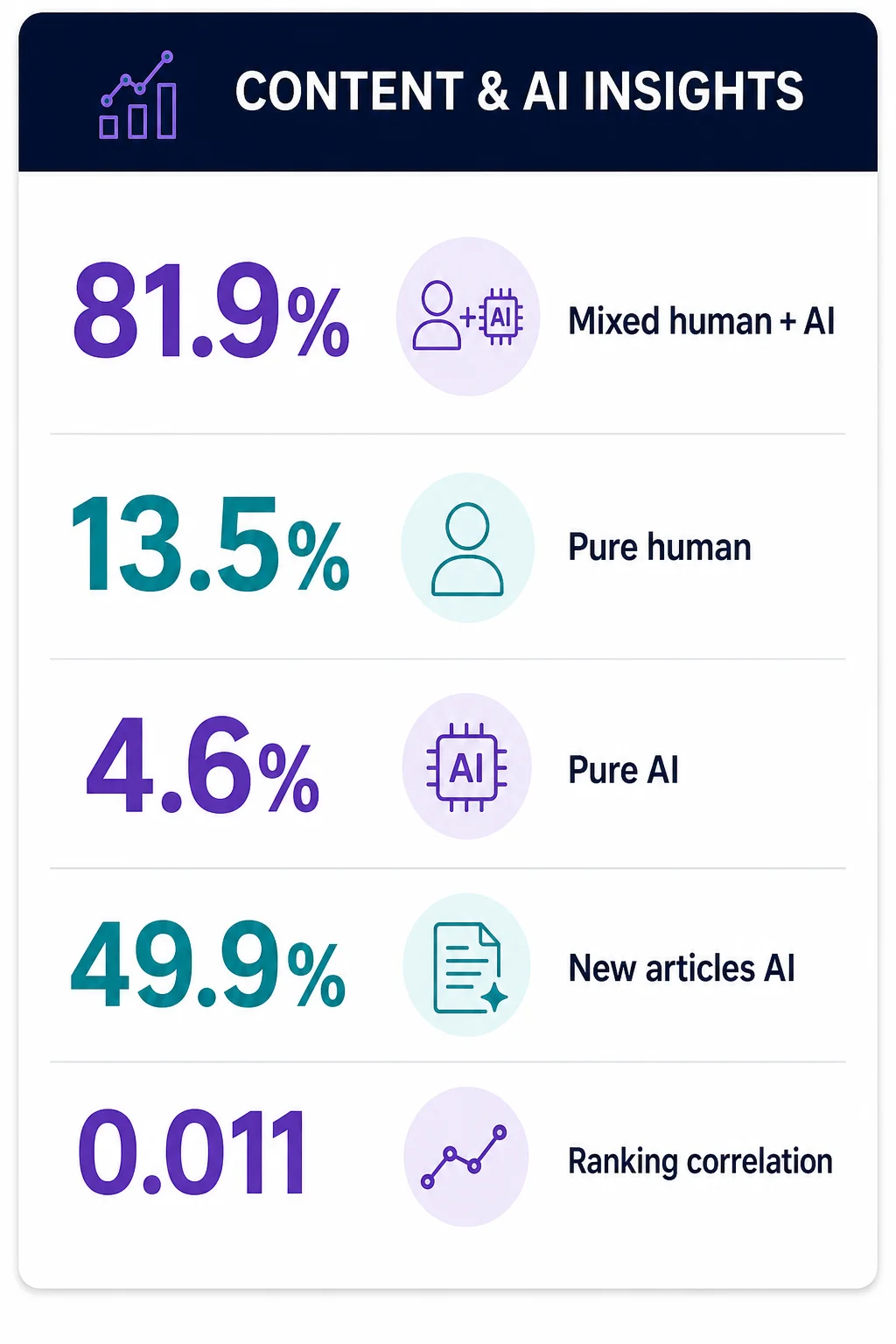
- → Ahrefs measured 600,000 pages and found the correlation between AI content share and ranking position is 0.011, which is effectively zero (Ahrefs, 2025)
- → Semrush analysed 42,000 blog posts and found purely AI content takes position one only 9% of the time, against 80% for human writing (Semrush, 2025)
- → Primarily AI-generated articles have sat near 50% of new publishing for five straight quarters, at 49.9% in Q1 2026 (Graphite, 55,400 articles)
- → Only 2.5% of new webpages are pure AI, while 74.2% contain some AI (Ahrefs, 900,000 pages)
- → Google’s spam policy targets scaled content abuse, not AI authorship, which it does not prohibit (Google Search Central)
- → AI Overviews cut clicks to the number one organic result by 34.5%, so ranking converts to traffic less reliably than it did (Ahrefs, 300,000 keywords)
An autoblogger is software that researches, writes and publishes blog posts with little or no human involvement, and in 2026 it costs roughly thirty cents a run.
That price has produced a strange information environment.
The people selling autoblogging cite the studies that flatter it, the people selling AI detection cite the studies that damn it, and almost nobody has put the underlying datasets side by side to see whether they even agree.
They do not.
This piece works through the four largest public datasets on AI content and search, notes exactly where each one was funded and what it actually measured, and lands on the one number that answers the question most people are really asking.
1 Autoblogger scale: how much of the web is machine-written now?
Roughly half of new articles are primarily AI-generated, and that share has stopped growing. Graphite sampled 55,400 articles from Common Crawl and found primarily AI-generated articles were 49.9% of new articles in Q1 2026, down slightly from a Q4 2025 peak of 50.9%. The proportion has hovered near 50% for five consecutive quarters.
| Metric | Value | Source |
|---|---|---|
| New articles primarily AI-generated, Q1 2026 | 49.9% | Graphite (55,400 articles) |
| New articles primarily AI-generated, Q4 2025 (peak) | 50.9% | Graphite |
| New articles primarily AI-generated, Q1 2025 | 49.6% | Graphite |
| New webpages containing any AI content | 74.2% | Ahrefs (900,000 pages) |
| New webpages that are pure AI | 2.5% | Ahrefs |
| New webpages that are pure human | 25.8% | Ahrefs |
| Content marketers using AI in some form | 87% | Ahrefs survey (n=879) |
The two studies look contradictory and are not.
Graphite counted articles and asked whether the majority of each one was machine-written, which gets you to about half.
Ahrefs counted pages and asked whether any AI was present at all, which gets you to three quarters, and then found that almost none of those pages were purely machine-made.
Read together they describe the same world: AI is now involved in most published writing, and almost never left alone with it.
There is one claim in this area worth handling carefully, because it has escaped its own caveat.
Graphite’s write-up notes that these AI articles “largely do not appear in Google and ChatGPT”, and that line now circulates across the industry as a finding.
It is not one.
The same document says plainly: “We do not evaluate whether AI-generated articles get as much traffic as human-written articles, but we suspect that they do not.”
That is an author’s stated suspicion, and it is being quoted as measurement, which is the kind of drift worth checking before you build a strategy on it.
2 Does Google penalise autoblogged content?
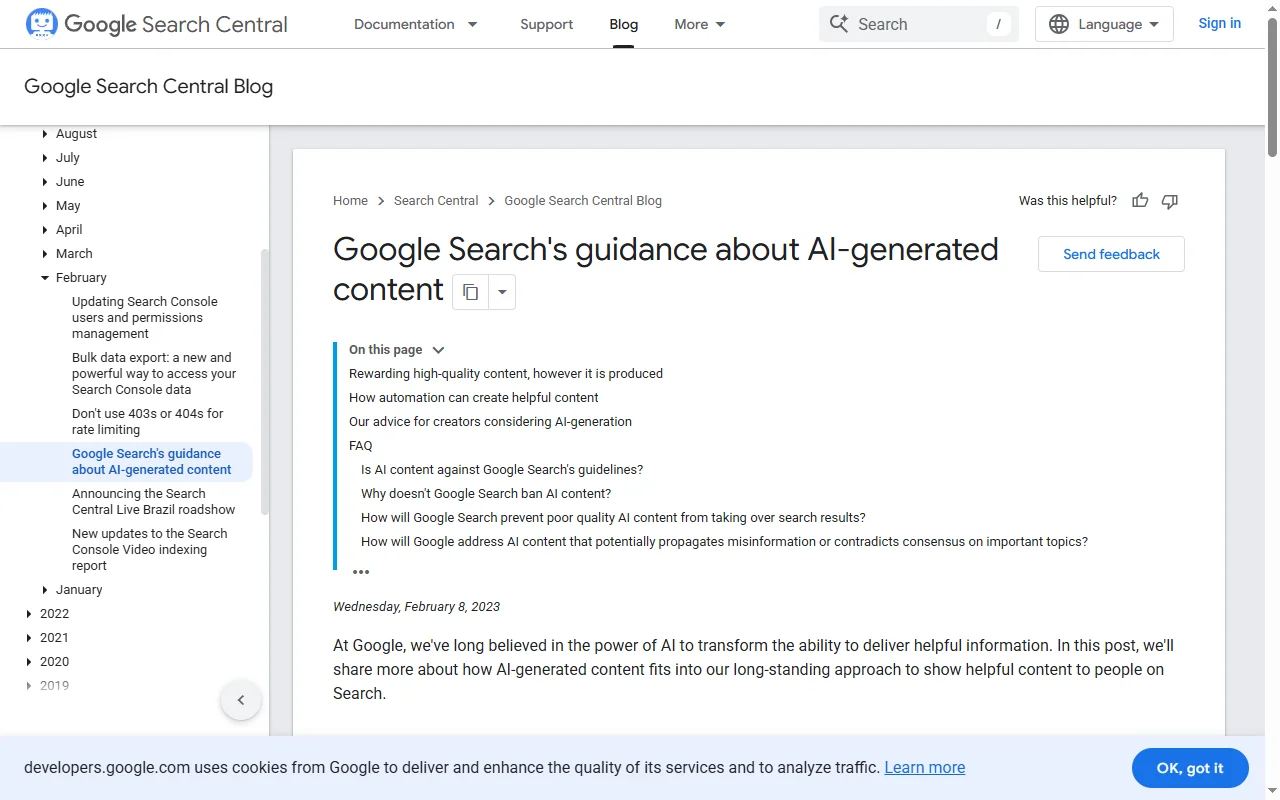
Not for being AI-written. Google’s spam policies do not prohibit AI authorship. They target scaled content abuse, defined as generating many pages primarily to manipulate search rankings with little or no value added for users. The penalty attaches to thin, unreviewed volume, not to the tool that produced it.
This is the single most misreported area in the niche, so it is worth quoting the policy rather than the commentary about the policy.
Google’s own documentation defines scaled content abuse as “generating many pages primarily to manipulate search rankings, with little or no value added for users”, and the word “AI” does not appear in that definition.
The policy dates to the March 2024 spam update, not to any 2026 announcement, despite a persistent claim that a recent core update singled out AI content by name.
Google does not name targets for core updates, which address relevance, and it enforces spam policy separately.
| Metric | Value | Source |
|---|---|---|
| Google policy position on AI authorship | Not prohibited | Google Search Central |
| Correlation, AI content share to ranking position | 0.011 | Ahrefs (600,000 pages) |
| Sites with a manual action, of 79,000 checked | 1,446 (1.8%) | Originality.ai (March 2024) |
| Manual-action sites that had likely published AI content | 151 of 175 (86%) | Originality.ai |
| Manual-action sites that were 95%+ AI-generated | 51 of 175 (29%) | Originality.ai |
The Originality.ai rows need reading with care, and the company would probably agree.
Their study establishes correlation, not causation: it observed that sites hit with manual actions tended to have AI content, which is not the same as showing that the AI content caused the action.
Originality.ai also sells AI detection, so a finding that AI content correlates with penalties aligns neatly with its commercial interest, and the authors themselves flag sampling bias because the sites were drawn from three advertising networks.
Their data is still the only public dataset connecting manual actions to a measured AI share, which is why it appears here at all rather than being discarded.
None of this makes autoblogging safe, and the distinction matters more than it sounds.
Publishing four hundred unreviewed pages a month to blanket a keyword set is scaled content abuse whether a person or a model typed it, which is the same logic behind why a thin AI wrapper struggles to hold value once the novelty passes.
3 Three studies asked whether AI ranks, and they disagree
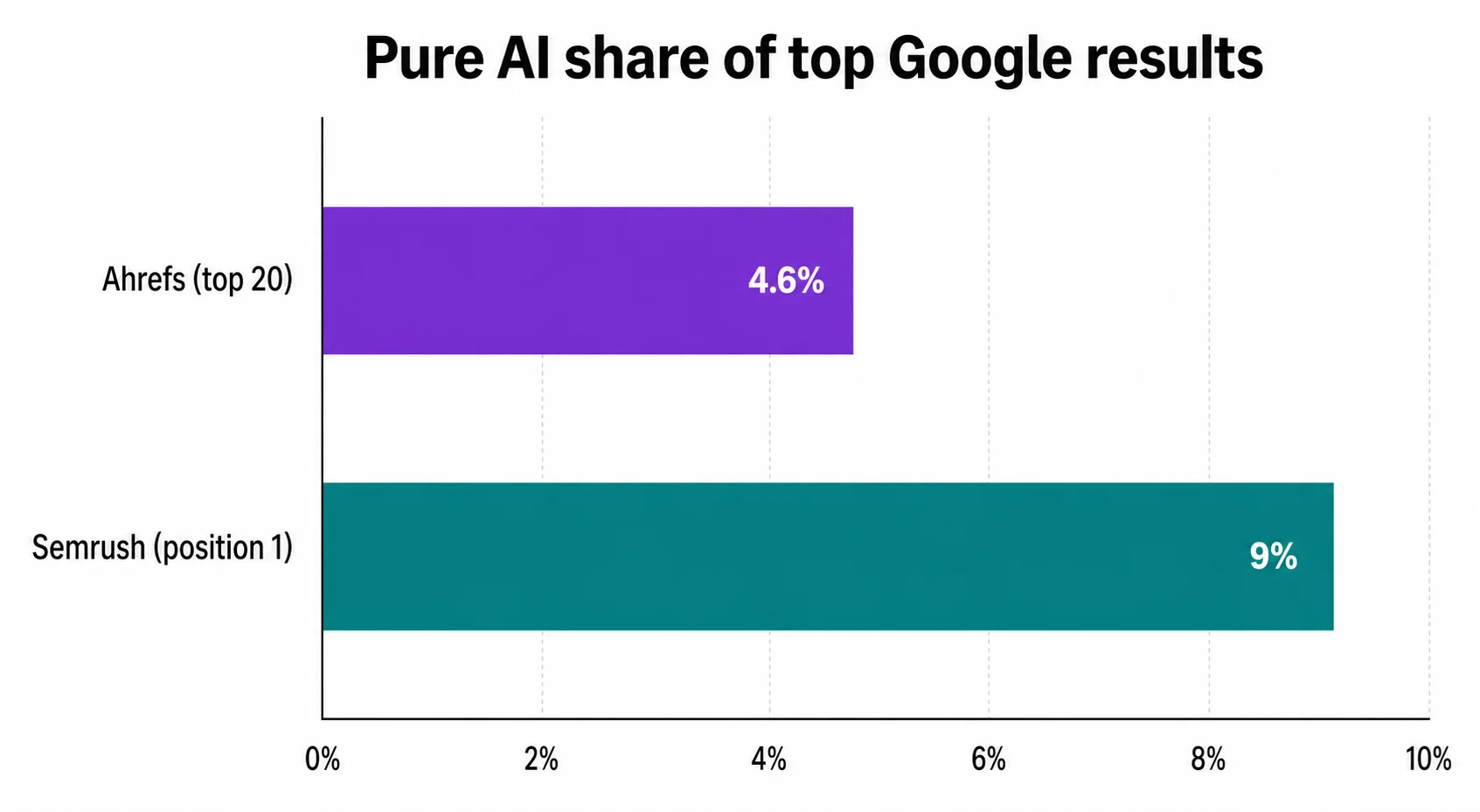
Ahrefs analysed 600,000 pages and found no relationship between AI share and ranking position. Semrush analysed 42,000 blog posts and found purely AI content reaches position one just 9% of the time against 80% for human writing. Both used different detectors, measured different things, and can be simultaneously correct.
| Study | Sample and finding | Detector |
|---|---|---|
| Ahrefs, July 2025 | 600,000 pages: correlation 0.011 | Ahrefs bot_or_not |
| Semrush, November 2025 | 42,000 posts: pure AI at position 1 = 9% | GPTZero |
| Rankability, 2026 | 487 results: 83% scored human-written | Proprietary blend |
| SEOs who believe AI ranks as well or better | 72% | Semrush (n=224) |
The resolution here is methodological rather than factual, and it is the most useful thing in this article.
Ahrefs measured correlation across the whole top 20 and found no gradient, meaning AI-heavy pages are not pushed down as they get more AI-heavy.
Semrush measured composition at position one specifically and found human writing overrepresented at the very top.
Both results hold at once: there is no penalty slope, and the summit is still disproportionately human.
The incentive structure is worth noticing too, because it points the opposite way to the usual assumption.
Semrush sells an AI content generator and still published a finding that purely AI content rarely reaches position one, which is evidence against its own commercial interest and therefore carries more weight, not less.
Originality.ai and Rankability sell AI detection, and both produced findings that happen to support buying AI detection.
Rankability, to its credit, describes its own work as “a directional study with a focused sample, not a definitive analysis”, which is a fair description of 487 results.
Every study on this page shares one weakness, and each vendor admits it.
All of them depend on AI detectors, and Ahrefs states its tools are “statistical models” dealing in “probabilities, not certainty”, while Graphite averaged three separate detectors precisely because no single one is trustworthy.
Detection is also getting harder to reason about rather than easier: a University of Maryland and Google DeepMind preprint analysed 61,608 stories and found narrative structure alone identifies machine authorship at 93.2% macro-F1, with editing out the stylistic tells barely denting it.
That research covers fiction rather than blog posts, so it does not transfer directly, and it is worth flagging that nobody has run the equivalent study on commercial blog content.
4 What actually ranks: the 81.9% nobody quotes
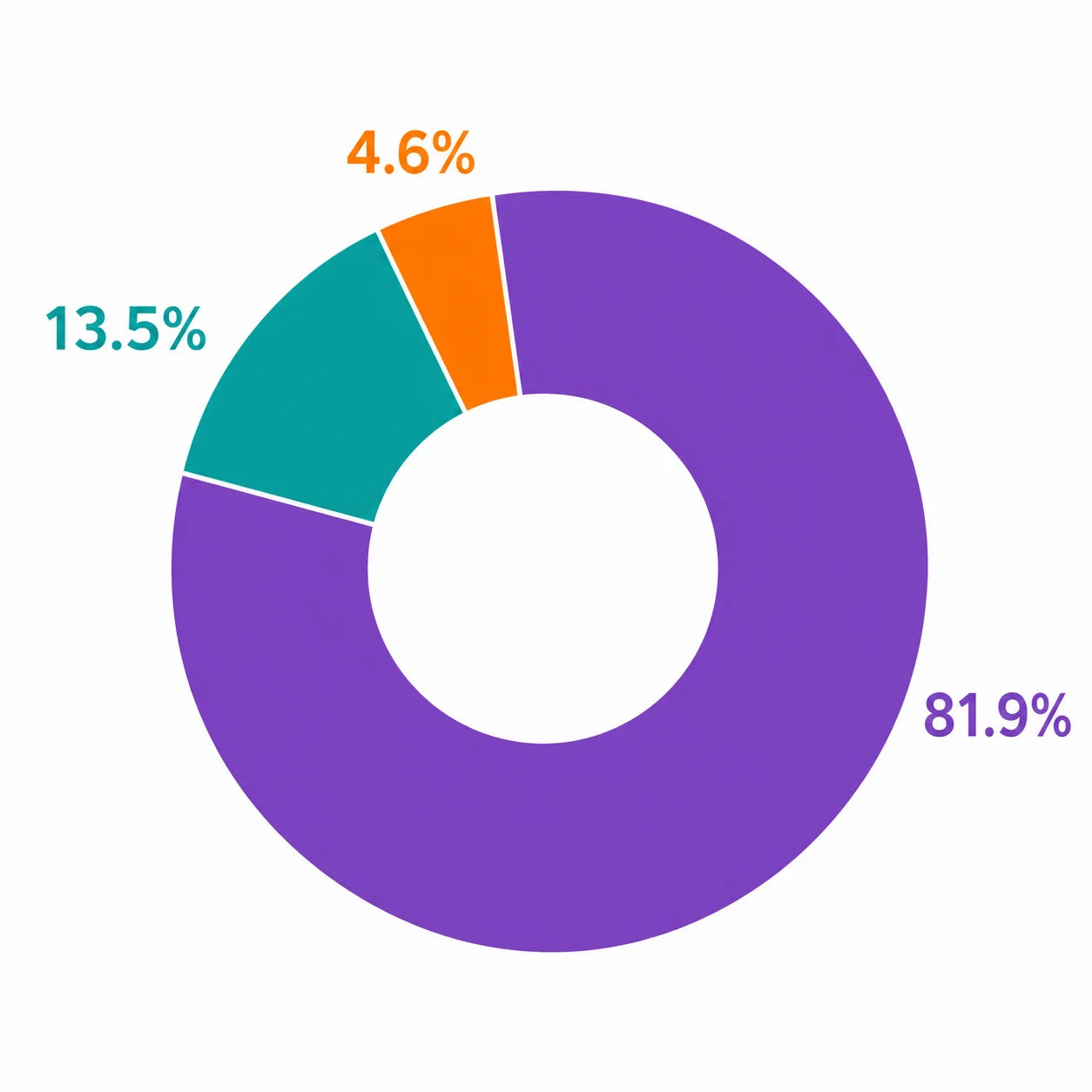
The pages that rank are hybrids. Across the top 20, 81.9% mix human and AI writing, 13.5% are pure human and only 4.6% are pure AI. The argument about whether to autoblog or write by hand is being had about 18% of the web, while the answer sits in the other 82%.
The survey data lines up with the ranking data, which does not happen often enough to ignore when it does.
Semrush found 73% of marketers use a combination of AI and human writing, and 69% specifically refine AI drafts by hand rather than shipping them.
Neither pure position is where the practitioners are, and neither is where the results are.
The vibe coding community reached this conclusion by a different route, which is that the projects that ship are rarely the ones left entirely to the model.
Autoblogging fails on the same principle for the same reason.
There is one honest conflict left in the data, and papering over it would be the easy option.
NP Digital reports that human-written content pulled 5.44 times the traffic of AI content by month five, at 283 visitors a month against 52.
Ahrefs reports that websites using AI content grow around 5% faster than those that do not.
Those point in opposite directions, and two details explain most of the gap: NP Digital compared human writing against completely unedited AI output rather than the edited hybrid that 81.9% of ranking pages actually use, and NP Digital sells human content services.
The reasonable reading is that raw model output underperforms and edited output does not, which is exactly what the composition data shows.
5 What an autoblogger actually costs in 2026
Generation is close to free. Autoblogging.ai’s entry tier is $12 a month on annual billing for 40 credits, which puts a standard article at roughly $0.31 and a higher-quality run at $0.62. At enterprise volume the per-credit cost falls to about $0.13.
| Metric | Value | Source |
|---|---|---|
| Entry tier, monthly cost on annual billing | $12 | Autoblogging.ai |
| Entry tier, credits included per month | 40 | Autoblogging.ai |
| Cost per standard article (Quick Mode, 1 credit) | $0.31 | Autoblogging.ai |
| Cost per higher-quality article (Godlike Mode, 2 credits) | $0.62 | Autoblogging.ai |
| Enterprise tier, cost per credit | $0.13 | Autoblogging.ai |
These are the vendor’s own published figures rather than an affiliate roundup’s estimate, which matters because the roundups in this niche are ranked by commission rather than by testing.
The number that should reframe the decision is what it implies rather than what it says.
At thirty-one cents a post, the cost of producing content has fallen below the cost of thinking about whether to produce it.
When generation costs nothing, generation stops being the strategy.
The scarce inputs become editorial judgement, a real point of view and somewhere durable to publish, which is the same shift that happened to app building once the tools stopped being the hard part.
6 AI blog automation on WordPress: the distribution problem
Most AI blog automation runs on WordPress, and the hard part is no longer publishing. It is being read. AI Overviews cut clicks to the number one result by 34.5%, and the share of AI Overview citations drawn from the organic top 10 fell from 76% to 38% between July 2025 and March 2026.
| Metric | Value | Source |
|---|---|---|
| Click reduction at position 1 from AI Overviews | 34.5% | Ahrefs (300,000 keywords) |
| Position 1 clickthrough rate, before and after AI Overviews | 0.073 to 0.026 | Ahrefs |
| AI Overview citations drawn from the organic top 10 | 38% (was 76%) | Ahrefs (863,000 SERPs) |
| ChatGPT share of trackable standalone LLM referrals | 92.4% | Previsible (6.77M sessions) |
| Americans who trust AI search | 28% | YouGov (19 markets) |
Two of those rows carry caveats that get stripped whenever they are quoted elsewhere.
Previsible’s 92.4% figure covers standalone LLM referrals only and explicitly excludes AI Overviews, and Previsible themselves note that AI discovery happening inside Google probably exceeds every standalone platform combined.
The YouGov trust figure comes from a livestream presentation with no published sample size, and it ranks the United States last of 19 markets surveyed, which is a finding about Americans rather than about search.
Put the operational picture together and the autoblogging pitch inverts.
Publishing is solved and cheap, ranking is achievable, and converting a ranking into a human being on your page is measurably harder than it was eighteen months ago.
An autoblogger increases your supply into the exact part of the funnel that is contracting.
That is not an argument against automation, it is an argument for aiming it at things worth citing, which is why the assets that hold up are usually the ones carrying original data rather than the ones carrying volume.
If you are running AI blog automation on WordPress, the practical stack question follows from the cost data above.
Scheduled generation jobs, API calls and a growing index are all server-side work, and shared entry-level hosting tends to be the first thing that breaks when a pipeline starts running nightly.
That is the same reasoning behind running persistent AI sessions on a VPS rather than a laptop, and it applies identically here.
Hostinger (Business or VPS hosting)
At roughly $0.31 per generated article, writing is no longer the cost centre in an AI blog pipeline. The constraint is the stack underneath it: WordPress automation needs hosting that can carry scheduled jobs, API calls and a growing index without falling over, which is where a Business or VPS plan does more work than the writing tool does.
See Hostinger plans →We have covered the hosting side in more depth in our breakdown of why Hostinger suits vibe coders, and separately reviewed Hostinger Horizons for the build-and-ship end of the same stack.
7 Work out your real cost per post
Generation cost is trivial and editing cost is not. This calculator uses the published Autoblogging.ai per-article prices and your own editing time to show what a post actually costs you, and which bucket from the Ahrefs composition data you would land in.
The output most people find uncomfortable is the editing share.
Once you put any realistic value on your own time, generation drops to a rounding error and the entire cost of an AI blog becomes the human attention you give it, which is precisely the input that pure autoblogging is designed to remove.
Methodology
This article curates published research rather than presenting original experiments, and every figure traces to a named source with a stated sample size.
Claims were checked against primary sources rather than against articles repeating them, which changed two numbers during research.
- Sources consulted: 29 across official documentation, academic preprints, industry research and vendor pricing pages
- Sources cited: 16, of which 10 are original research with disclosed methodology
- Data range: March 2024 to July 2026, with 13 of 16 cited sources carrying 2025 or 2026 data
- Last verified: 14 July 2026
- Update schedule: Quarterly, or whenever a major ranking study is published
Limitations worth stating plainly
- No study located measures autoblogging outcomes specifically. Every ranking dataset here measures AI content broadly, which includes AI-assisted work. Where this article discusses autoblogging, it is reasoning from adjacent data rather than direct evidence.
- Every ranking study depends on an AI detector, and every vendor concedes its detector is imperfect. Ahrefs used its own model, Semrush used GPTZero, Rankability used a blend, and Graphite averaged three. Cross-study comparison is confounded by this and cannot be fully resolved.
- Vendor incentive is uneven. Semrush sells an AI content generator and reported findings against that interest, which strengthens its result. Originality.ai and Rankability sell AI detection, and their findings align with their interest, which weakens theirs.
- The Originality.ai data is from March 2024 and is retained because it remains the only public dataset tying manual actions to a measured AI share. No superseding study was found.
- Two widely-circulated claims were excluded for failing verification: a “50 to 80% traffic drop” figure that traces to a single vendor blog with no methodology, and a case study claiming zero to 100,000 monthly visitors whose publisher sells the product credited for the result.
Frequently Asked Questions
Does Google penalise autoblogged content?
Not for being AI-written. Google’s spam policies target scaled content abuse, defined as generating many pages primarily to manipulate rankings with little or no value added for users. Ahrefs measured 600,000 pages and found the correlation between AI content share and ranking position was 0.011, effectively zero. The penalty risk attaches to thin, unreviewed volume, not to the tool that produced it.
Does AI content actually rank on Google?
The three largest datasets disagree. Ahrefs found no correlation between AI share and position across 600,000 pages. Semrush analysed 42,000 blog posts and found purely AI content took position one just 9% of the time against 80% for human writing. Both can be true: no linear penalty across the top 20, but human writing is still overrepresented at the very top.
How much does an autoblogger cost in 2026?
Generation is close to free. Autoblogging.ai’s entry tier is $12 a month on annual billing for 40 credits, putting a Quick Mode article at roughly $0.31 and a Godlike Mode article at $0.62. Enterprise volume drops to about $0.13 per credit. Cost is no longer the constraint on publishing.
What percentage of the internet is AI-generated?
Graphite sampled 55,400 Common Crawl articles and found primarily AI-generated articles were 49.9% of new articles in Q1 2026, having sat near 50% for five straight quarters. Ahrefs, measuring pages rather than articles, found 74.2% of new pages contain some AI but only 2.5% are pure AI.
Is autoblogging worth it in 2026?
The data does not support pure automation as a ranking strategy. Only 4.6% of pages in Google’s top 20 are pure AI, while 81.9% are a human and AI mixture. Semrush found 69% of marketers refine AI drafts by hand. The economics favour generating cheaply and editing seriously, not publishing unread. Our complete guide to vibe coding covers the same trade-off applied to building rather than writing.
Can Google detect AI content?
No detector is reliable, and every vendor running these studies says so. Ahrefs, Semrush and Rankability used different detectors and reached different conclusions, and each states its tool carries false-positive risk. Separately, a University of Maryland and Google DeepMind preprint found narrative structure alone identifies AI-written fiction at 93.2% macro-F1, though that research covers fiction and not blog content.
What is the difference between autoblogging and AI-assisted blogging?
Autoblogging publishes machine output without human review. AI-assisted blogging uses the machine for the draft and a person for judgement. The distinction matters because 81.9% of pages ranking in Google’s top 20 are mixed rather than pure, and 73% of marketers report using a combination rather than either extreme. If the terminology here is unfamiliar, our glossary of vibe coding terms covers the basics.
Do AI-written blogs get cited by ChatGPT and AI Overviews?
Citation now runs through position, and position converts to traffic less reliably than it did. Ahrefs found AI Overviews cut clicks to the number one result by 34.5%, and that the share of AI Overview citations drawn from the organic top 10 fell from 76% to 38% between July 2025 and March 2026. Previsible’s analysis of 6.77 million sessions found ChatGPT takes 92.4% of trackable standalone LLM referrals, though that figure excludes AI Overviews entirely.
Sources and References
- Ahrefs. “AI-Generated Content Does Not Hurt Your Google Rankings (600,000 Pages Analyzed).” ahrefs.com. Published 7 July 2025. Accessed 14 July 2026.
- Ahrefs. “74% of New Webpages Include AI Content (Study of 900k Pages).” ahrefs.com. Accessed 14 July 2026.
- Ahrefs. “AI Overviews Reduce Clicks by 34.5%.” ahrefs.com. Accessed 14 July 2026.
- Ahrefs. “Update: 38% of AI Overview Citations Pull From The Top 10.” ahrefs.com. Accessed 14 July 2026.
- Ahrefs. “Websites Using AI Content Grow 5% Faster.” ahrefs.com. Accessed 14 July 2026.
- Graphite. “AI Now Writes as Many Online Articles as Humans Do.” graphite.io. Data through Q1 2026. Accessed 14 July 2026.
- Semrush. “Can AI Content Rank on Google? We Analyzed 20K Blog URLs.” semrush.com. Data November 2025. Accessed 14 July 2026.
- Rankability. “Does Google Penalize AI Content? SEO Study (2026).” rankability.com. Accessed 14 July 2026.
- Originality.ai. “Can Google Detect and Does it Penalize AI Content.” originality.ai. Data March 2024. Accessed 14 July 2026.
- Autoblogging.ai. “Pricing.” autoblogging.ai. Accessed 14 July 2026.
- Google Search Central. “Spam Policies for Google Web Search.” developers.google.com. Accessed 14 July 2026.
- Google Search Central. “Google Search’s Guidance on Generative AI Content.” developers.google.com. Accessed 14 July 2026.
- Russell, J., Rajendhran, R., Pham, C.M., Iyyer, M., Wieting, J. “StoryScope: Investigating idiosyncrasies in AI fiction.” arXiv:2604.03136. Preprint, under review. arxiv.org. Accessed 14 July 2026.
- Previsible. “2026 State of AI Discovery Report.” previsible.com. Released 6 July 2026. Accessed 14 July 2026.
- YouGov, via Search Engine Journal. “Only 28% Of Americans Trust AI Search.” searchenginejournal.com. Survey presented 8 July 2026. Accessed 14 July 2026.
- NP Digital. “AI vs Human: Who Writes Better Blogs That Get More Traffic?” neilpatel.com. Accessed 14 July 2026.
Last updated: 14 July 2026.