Vibe Coding vs No-Code: What’s the Difference in 2026?
Key Takeaways
- → Vibe coding uses AI to write real, editable source code from plain-English prompts, while no-code builds apps from visual blocks with no code at all (IBM; Kissflow)
- → The term “vibe coding” was coined on 2 February 2025 by Andrej Karpathy, OpenAI co-founder and former Tesla AI lead (Karpathy, X)
- → Gartner puts 70% of new apps on low-code or no-code by 2025, from under 25% in 2020 (Gartner)
- → The low-code development technologies market is worth roughly $44.5B in 2026, growing about 19% a year (Gartner)
- → By 2026, at least 80% of low-code users are expected to sit outside formal IT, up from 60% in 2021 (Gartner)
- → The r/nocode community’s verdict on making money: “The real money is in a niche where you actually know the domain” (r/nocode)
- → Vibe-coded apps ship with no built-in governance: no approval workflows, version control or audit trails unless you add them (Kissflow)
- → For no-code builders, the hard part is shipping: native apps get rejected under Apple’s guideline 4.2 for reading as “a website in a wrapper” (r/nocode)
“Vibe coding” and “no-code” both promise the same thing: build software without a full development team.
They get to that promise through opposite doors, and confusing them is the fastest way to pick the wrong tool for your project.
This guide sets out exactly what separates them, using verified 2025 and 2026 data plus what builders are actually saying right now, and it pairs with our complete guide to vibe coding for the deeper background.
1 What is vibe coding, and what is no-code?
Vibe coding uses an AI model to generate real, editable source code from natural-language prompts, whereas no-code assembles a working app from visual drag-and-drop blocks that never produce code you can see or export.
The term “vibe coding” is young and precise.
Andrej Karpathy, an OpenAI co-founder and former Tesla AI lead, coined it on 2 February 2025 in a post describing a workflow where you “fully give in to the vibes, embrace exponentials, and forget that the code even exists”.
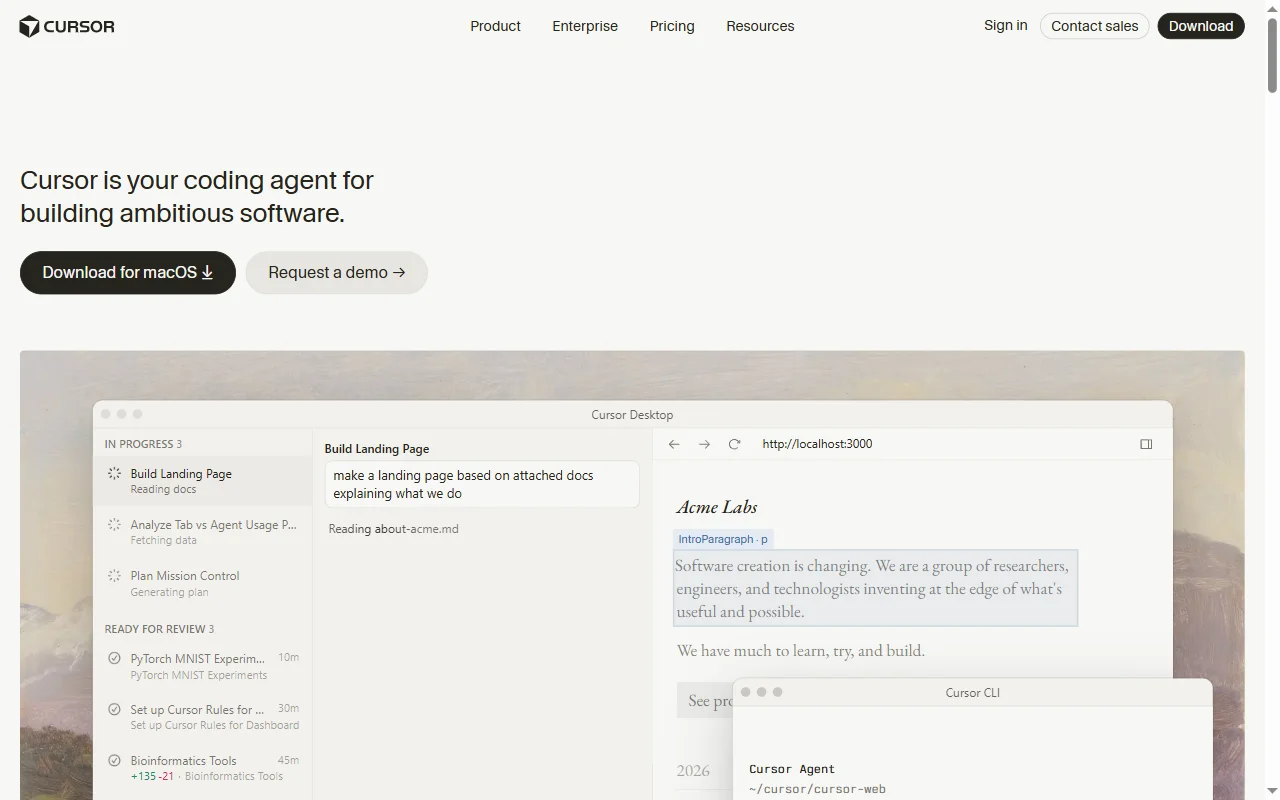
It builds on his earlier line that “the hottest new programming language is English”, and in practice it means guiding a tool like Cursor, Claude Code or Lovable to write, refine and debug the code for you.
| Metric | Vibe coding | No-code |
|---|---|---|
| What it produces | Real editable source code | Platform-locked visual app |
| How you build | Prompt an AI in plain English | Drag and drop visual blocks |
| Coined / origin | Karpathy, 2 Feb 2025 | Visual builders, 2010s |
| Example tools | Cursor, Claude Code, Lovable | Bubble, Webflow, Glide |
| Sources: Karpathy (X), IBM, Kissflow | ||
The distinction that matters most is ownership: vibe coding hands you code you can host and extend anywhere, which is why the natural next step is often hosting the result yourself.
If any of the terms here are unfamiliar, our vibe coding glossary defines them in plain English.
2 Vibe coding vs no-code: the core differences
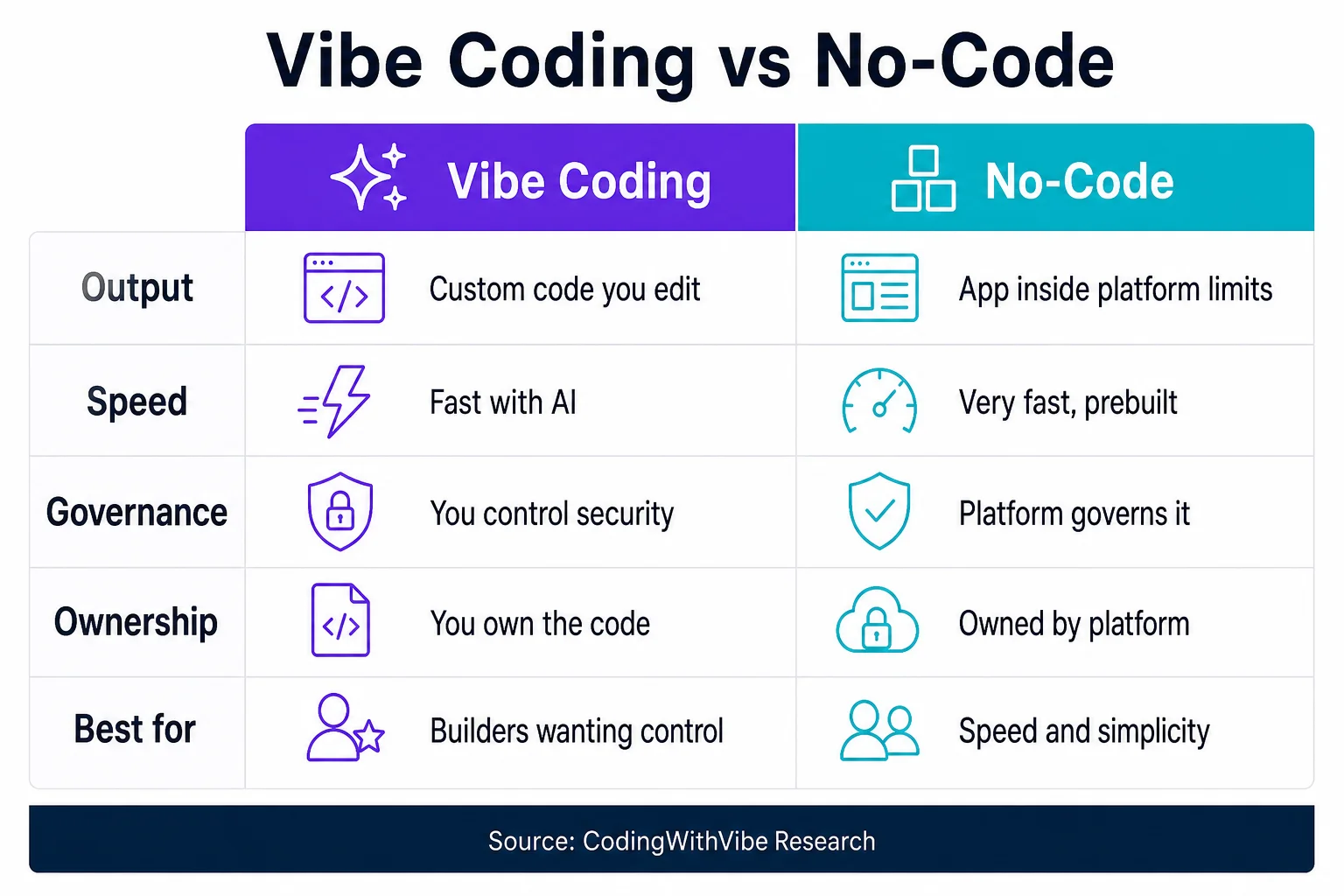
Across output, speed, governance and ownership the two approaches split cleanly: vibe coding trades built-in structure for flexibility and real code, and no-code trades flexibility for a governed, maintainable platform.
The comparison below is the one to screenshot if you only remember one thing from this page.
| Dimension | Vibe coding | No-code |
|---|---|---|
| Output | Custom code you can edit | App inside platform limits |
| Speed | Fast, varies with complexity | Very fast, prebuilt parts |
| Governance | You control security and data | Built in by the platform |
| Ownership | You own the code | Owned by the platform |
| Best for | Builders who want control | Structured, long-lived apps |
| Where it breaks | Production data and upkeep | Polish and app-store rules |
| Source: CodingWithVibe Research analysis of Kissflow and Knack, 2026 | ||
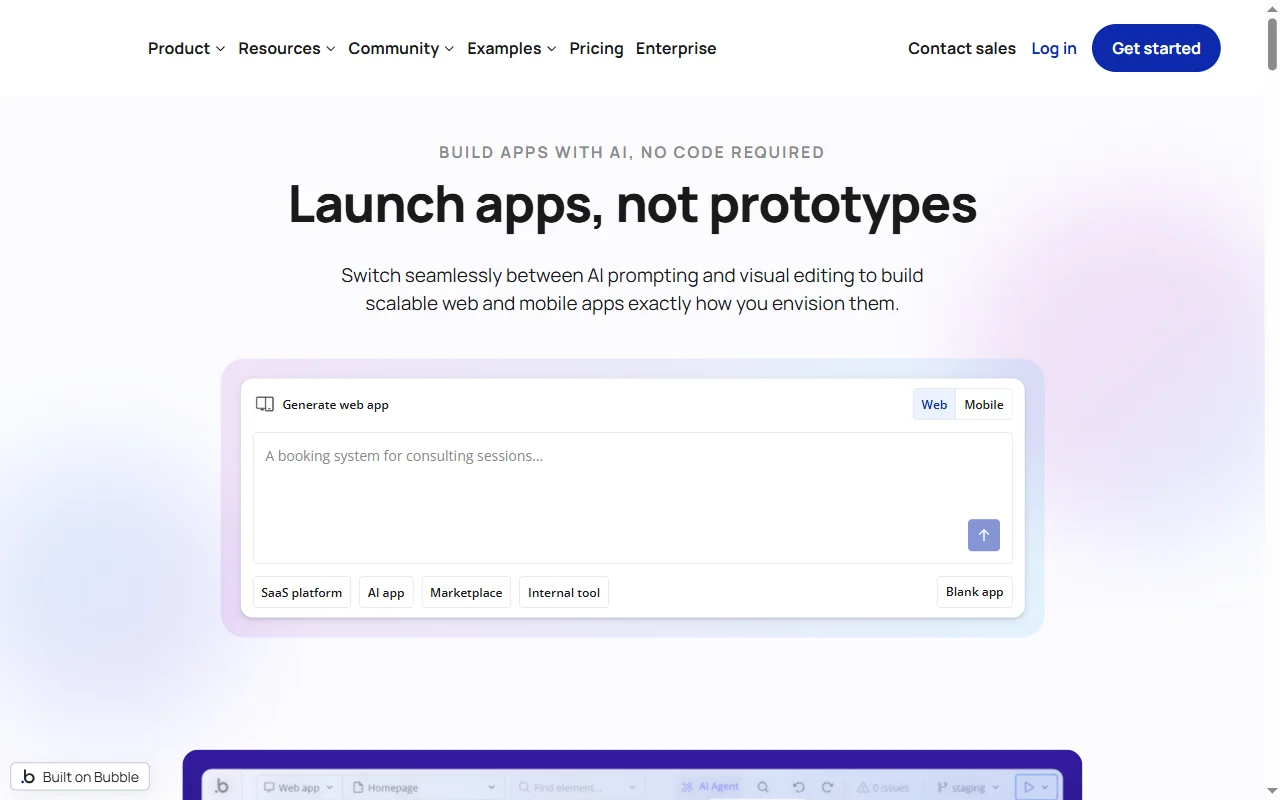
No-code has been quietly maturing while vibe coding grabs the headlines, and its own tools increasingly bolt AI generation on top, which you can see the moment you land on a builder like Bubble.
If your instinct is a data-heavy internal tool rather than a public product, our walkthrough on building a dashboard without code shows where no-code still wins outright.
3 How big is this, really? The adoption data
Build-it-yourself software is now mainstream, not fringe: Gartner expects 70% of new applications to run on low-code or no-code by 2025 and values the low-code market at around $44.5 billion in 2026.
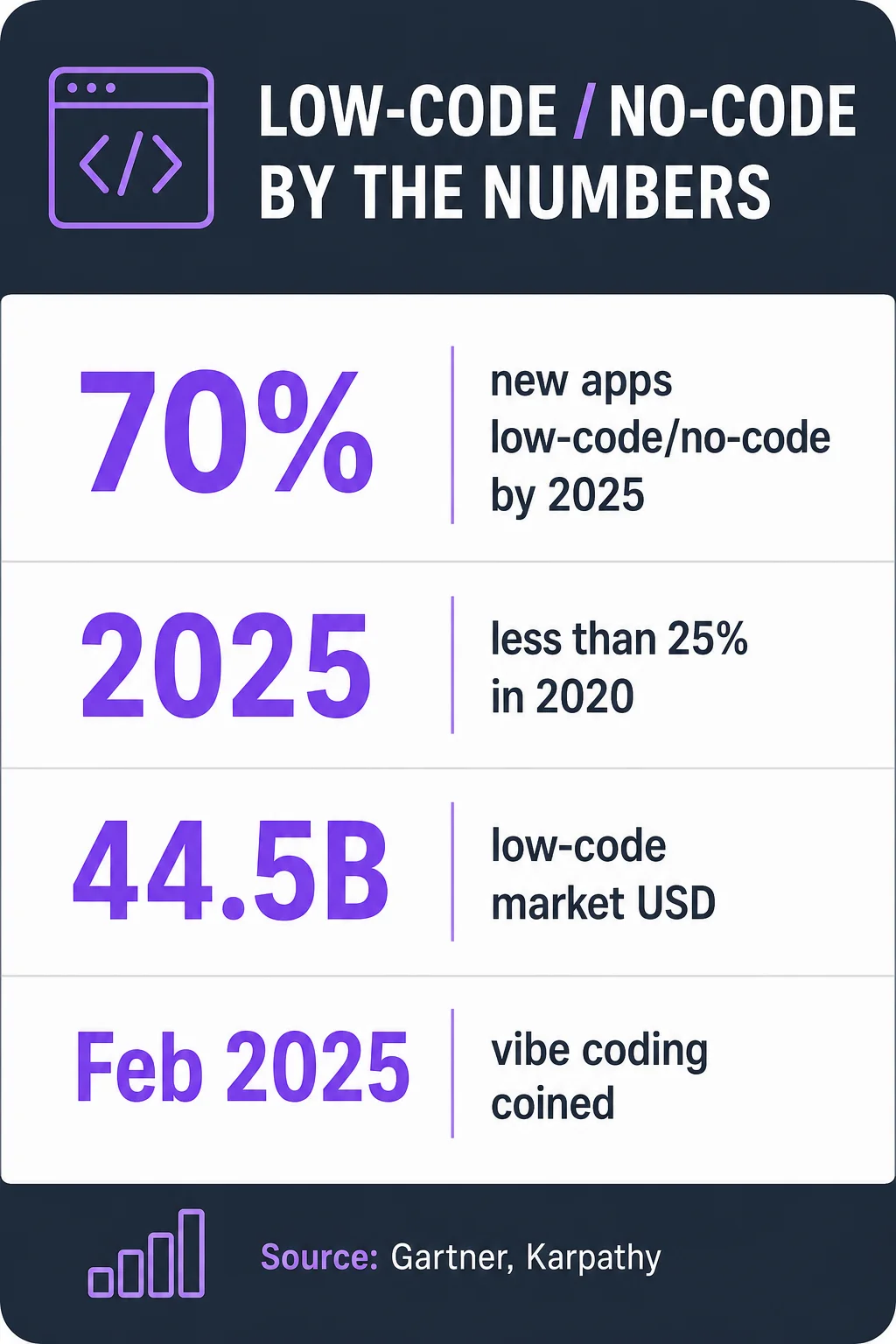
| Metric | Value | Source |
|---|---|---|
| New apps on low-code/no-code by 2025 | 70% | Gartner |
| Same figure in 2020 | under 25% | Gartner |
| Low-code market size, 2026 | $44.5B | Gartner |
| Low-code users outside IT by 2026 | 80% | Gartner |
| “Vibe coding” coined | Feb 2025 | Karpathy |
| Sources: Gartner; Karpathy (X) | ||
One number you may have seen elsewhere is worth flagging: a widely-shared claim of a “$4.7 billion vibe coding segment growing 85% a year” traces back to a single blog with no primary source, so we have left it out.
For the figures that do hold up, the wider vibe coding statistics we track give the full picture of how fast this space is moving.
4 Which should a non-developer choose?
Choose vibe coding for a fast prototype you own and can extend, and choose no-code for a structured app that has to stay consistent and maintainable over time.
The community view, echoed across Reddit and analyst write-ups alike, is that these are parallel paths rather than rivals.
If your project is a paying product where speed and ownership matter most, vibe coding tends to win, and choosing between the leading tools is its own decision covered in our Claude Code vs Cursor breakdown, with the wider field mapped in our guide to which AI coding tool actually ships products.
If you are weighing whether a non-developer can realistically ship at all, the honest answer sits in our data on how often non-developers actually ship a finished product.
Still unsure which tool matches your exact use case, budget and timeline, our tool finder quiz narrows eight options down to one in five questions.
5 The catch: governance, security and shipping
Vibe coding’s weak spot is governance and security, because nothing is built in by default, and no-code’s weak spot is the last mile of polish and app-store compliance.
Analysts are blunt about the vibe coding gap.
Vibe-coded apps have no built-in approval workflows, version control, role-based access or audit trails, so every governance layer has to be coded or bolted on after the fact.
No-code has the opposite problem, and its builders are candid about it.
On r/nocode, one builder summed up the money question with “the real money is in a niche where you actually know the domain”, making clear that the tool is never the moat.
There is even a cultural tell for hastily vibe-coded apps, with a widely-viewed TikTok noting that heavy purple and blue gradients give the game away.
The pragmatic pattern builders keep landing on is to use vibe coding for the fast, ugly first version and then move to structured tooling when the thing needs to survive real users, and seeing real apps built this way makes the trade-off concrete.
Methodology
This comparison combines primary-source verification with a 30-day scan of what builders are saying, then filters every claim through a five-lens fact-check.
- Sources cited: 10 across analyst research, primary definitions, technology press and community threads
- Community window: 16 June to 16 July 2026 across Reddit, X, YouTube, TikTok and Hacker News
- Verification: claims traced to primary sources; two commonly-repeated numbers were rejected as unverifiable and excluded
- Last verified: 16 July 2026
- Update schedule: reviewed quarterly, or sooner if Gartner or first-party definitions change
Frequently Asked Questions
What is the difference between vibe coding and no-code?
Vibe coding uses AI to write real, editable source code from plain-English prompts (Cursor, Claude Code, Lovable).
No-code assembles an app from visual drag-and-drop blocks and never generates code you can see (Bubble, Webflow).
One gives you code you own; the other gives you a platform-locked app.
Is vibe coding the same as no-code?
No.
No-code produces zero code – you build visually.
Vibe coding produces genuine source code; you just describe what you want in English and an AI writes it.
Coined by Andrej Karpathy in February 2025, vibe coding is closer to programming than to no-code.
Which is better for non-developers?
It depends on the goal.
Vibe coding wins on speed to a first working prototype and gives you real code, but security and governance are your responsibility.
No-code is better for structured, long-lived apps thanks to built-in consistency – Gartner expects 80% of low-code users to sit outside IT by 2026.
Can you actually make money with either one?
Yes, but not because of the tool.
As one r/nocode builder put it, “The real money is in a niche where you actually know the domain.” Both approaches monetise when they solve a specific business problem – the build method is secondary.
Is vibe coding safe to use?
It carries more risk than no-code by default.
Critics highlighted by MIT Technology Review point to maintainability problems and security vulnerabilities when AI-generated code is accepted without review.
No-code platforms bake in governance; vibe coding leaves it to you.
What is vibe coding, exactly?
Vibe coding is AI-assisted development where you describe a task in plain English and a large language model writes the code.
Andrej Karpathy coined it in February 2025, describing a workflow where you “fully give in to the vibes… and forget that the code even exists.”
Do you own the code with vibe coding but not with no-code?
Broadly, yes.
Vibe coding produces real source files you can export, host and extend anywhere.
Most no-code apps live inside the platform that built them, so you trade portability for the platform’s built-in structure and maintenance.
Is no-code dead now that AI can vibe code?
No.
The community view is that they are parallel paths, not rivals.
No-code still wins on governance, consistency and long-term maintenance, while vibe coding wins on speed and flexibility.
Increasingly, no-code platforms are adding AI generation of their own.
Sources & References
- Andrej Karpathy. “There’s a new kind of coding I call vibe coding.” x.com. 2 Feb 2025.
- Wikipedia. “Vibe coding.” en.wikipedia.org. Accessed Jul 2026.
- IBM. “What is vibe coding?” ibm.com. Accessed Jul 2026.
- MIT Technology Review. “What is vibe coding, exactly?” technologyreview.com. 2025.
- Gartner. “Forecast Analysis: Low-Code Development Technologies, Worldwide.” gartner.com. 2026.
- Kissflow. “Vibe Coding vs No-Code vs Low-Code: Enterprise Guide 2026.” kissflow.com. 2026.
- Knack. “Vibe Coding Explained (2026 Guide).” knack.com. 2026.
- r/nocode. “Are people making money with no-code app builder tools?” reddit.com. 2026.
- r/nocode. “Building mobile apps with no-code and the App Store.” reddit.com. 2026.
- r/vibecoding. “vibe code.” reddit.com. 2026.
Last updated: 16 July 2026 · We experiment with the tools so you don’t have to guess.