Hostinger for Vibe Coders: 100 Reasons to Make It Your Default Stack (2026)
Key Takeaways
- → Hostinger for vibe coders starts at £4.49/mo on the Business plan, including 30 vibe coding credits, 50 websites and 5 managed Node.js app slots
- → Hostinger’s Business plan starts at £4.49/mo and includes 30 vibe coding credits, 50 websites, and 5 managed Node.js app slots (Hostinger)
- → Horizons generates full-stack apps including frontend, backend, database, authentication, file storage, and email from a single prompt (Hostinger)
- → Ecommerce is built into Horizons with no plugins or third-party store builders required, making it among the first vibe coding tools to offer this out of the box (Yahoo Finance)
- → SSH access, GitHub Actions deployment, and GitLab CI/CD pipelines are supported on shared plans, not just VPS tiers (Hostinger docs)
- → Kodee, Hostinger’s AI agent in hPanel, handles infrastructure tasks via natural language, reducing DevOps overhead for non-expert builders (Hostinger)
Vibe coding has a hosting problem.
Most AI-generated apps die in the gap between “it works locally” and “it’s live on the internet,” not because the code is wrong, but because the hosting platform wasn’t designed for how vibe coders work.
This post examines 100 concrete reasons Hostinger has become a natural default for vibe coders, organised across 10 categories from AI-native positioning to developer workflow support.
If you’re still choosing a builder before picking a host, the AI coding tool comparison for non-developers covers the builder decision in detail.
A Hostinger for Vibe Coders: AI-Native Positioning
Hostinger is one of the first mainstream hosting companies to explicitly adopt the term “vibe coding” in official educational content, framing the platform as a natural home for AI-native builders.
While most hosting companies still describe their products in terms of server space and bandwidth, Hostinger’s official tutorials explain vibe coding as focusing on high-level intent and letting AI handle routine logic.
That positioning shift matters because it signals the product roadmap: features are being built for the way AI-native builders actually work, rather than for traditional developers who manage infrastructure manually.
If you’re new to the terminology, the vibe coding glossary covers the vocabulary you’ll encounter across tools and tutorials.
| Positioning aspect | How Hostinger applies it | Source |
|---|---|---|
| Term adoption | Official tutorials use “vibe coding” explicitly | Hostinger [1] |
| Horizons framing | Marketed as “vibe coding platform” | Hostinger [4] |
| Target audience | Non-technical creators building with AI | Hostinger [1] |
| Messaging | “Describe it, launch it” across social content | Hostinger [8] |
| Workflow alignment | Prompt → iterate → ship loop | Hostinger [2] |
- Hostinger is one of the first mainstream hosting companies to explicitly adopt the term “vibe coding” in official educational content, making it legible and aspirational to newcomers.
- Horizons is marketed as an AI-powered app builder that lets users create full web apps via natural language prompts, aligning directly with the core vibe coding loop.
- Official tutorials explain vibe coding as focusing on high-level intent and letting AI generate boilerplate and routine logic, framing Hostinger as a default playground for this style of work.
- Hostinger documentation emphasises that users “describe what they want” rather than wiring everything manually, matching how vibe coders think when working with LLMs.
- Horizons supports prompt-based iteration, enabling users to refine apps by changing descriptions instead of rewriting code, mirroring refactor flows in tools like Cursor or Windsurf.
- Hostinger positions Horizons as suitable for micro-SaaS, client tools, and small business apps built from prompts, matching how many vibe coders monetise their projects.
- Marketing material explicitly calls Horizons a “vibe coding platform” with full-stack generation, helping creators mentally place Hostinger alongside AI-native builders rather than legacy hosting.
- Hostinger content shows non-technical users building functional tools with natural language only, reinforcing the idea that this is a platform for AI-generated software experimentation.
- Hostinger’s own vibe coding tutorials link directly from conceptual explanations to practical Horizons prompts, lowering the activation energy for trying the workflow.
- Social content around Horizons emphasises “describe it, launch it” messaging, which resonates with vibe coders accustomed to rapid generation in LLM chats.
B Full-Stack Generation and Built-In Backend
Horizons generates both frontend and backend from a single prompt, including database, authentication, file storage, and email, removing the most common blockers for vibe-coded apps going live.
The biggest bottleneck for AI-generated apps isn’t the front end: it’s everything behind it.
Horizons solves this by generating backend infrastructure alongside the UI, which removes the “now what?” moment that kills most vibe coding projects before they reach users.
For a detailed look at how Horizons performs in production, the Hostinger Horizons review breaks down the full-stack capabilities and where the platform’s limits currently sit.
| Full-stack component | Included by default | What it replaces |
|---|---|---|
| Database | Yes | External DB signup (Supabase, PlanetScale) |
| Authentication | Yes | Auth0, Clerk, or hand-rolled session code |
| File storage | Yes | S3 config or Cloudinary integration |
| Email sending | Yes | SMTP provider setup (Resend, SendGrid) |
| Custom domains | Yes | Separate DNS registrar management |
| Automatic backups | Yes | Manual snapshots or external backup tools |
- Horizons can generate both frontend and backend, including database, authentication, and file storage, making it one of the few vibe coding tools with native full-stack capabilities.
- Hostinger’s 2026 product updates confirm that Horizons ships fully working sites and web apps without extra setup, reducing integration friction for vibe coders who want to avoid DevOps overhead.
- Built-in databases eliminate the need to sign up for separate DB providers or configure ORMs after AI generation.
- Integrated authentication handles user accounts and login flows, removing a common stumbling block for AI-generated apps that need user sessions.
- Native file storage lets AI-generated apps handle uploads and media without DIY S3 configuration, which is tedious to accomplish via prompts alone.
- Included email sending means micro-SaaS or lead-generation tools can go live without configuring separate SMTP providers, speeding up the path from prompt to revenue.
- Horizons offers full-stack code editing on higher tiers, letting vibe coders generate with AI and then drop into code when they need precision.
- The ability to connect custom domains directly from within Horizons unifies DNS, hosting, and app logic under a single control surface, which suits solo builders.
- Automatic backups for Horizons apps reduce the risk of destructive prompts or experiments, encouraging more aggressive iteration.
- Basic built-in visitor metrics give vibe coders a starting point for measuring experiment performance without third-party setup.
C Integrated AI Website Builder and Content Tools
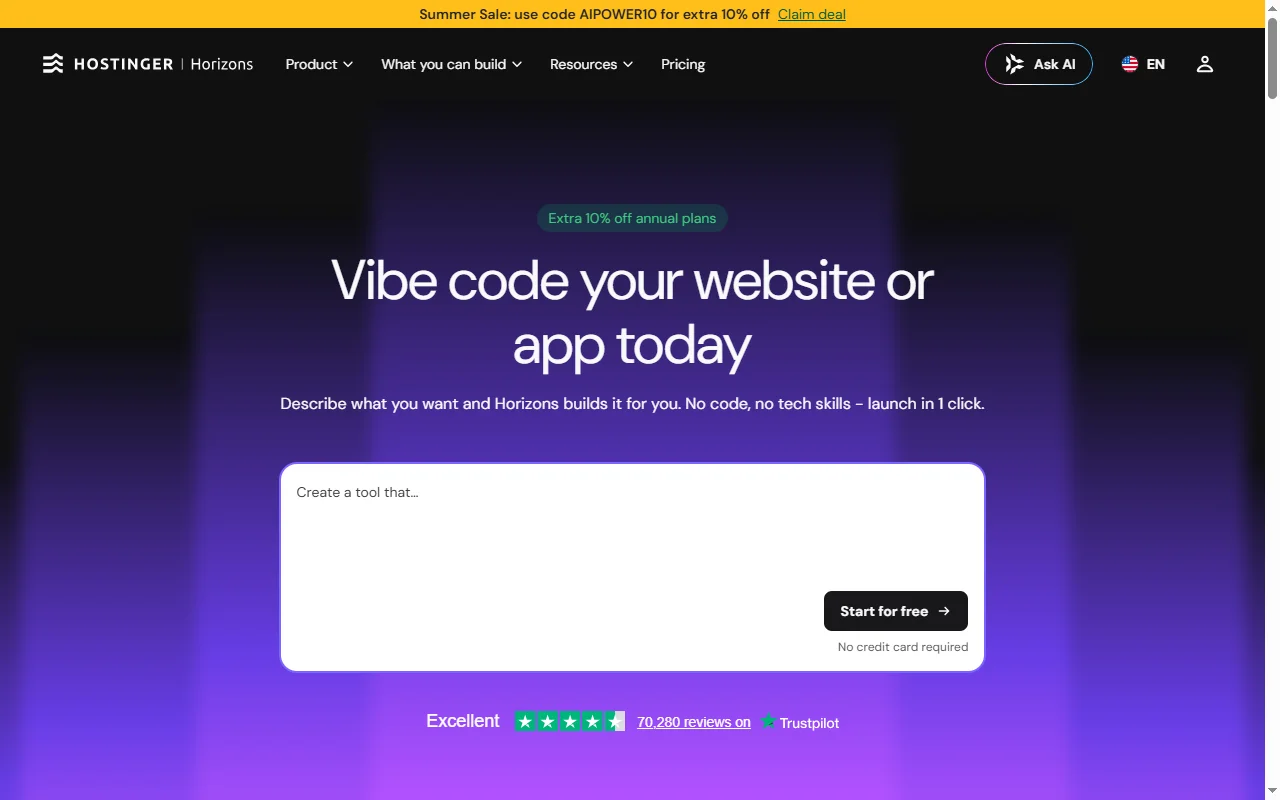
Hostinger’s AI website builder generates a complete site structure, layout, and content from a short description, with domain, SSL, and email all included under the same plan.
Not every vibe coding project is an app: many start as a website, content property, or ecommerce store.
Hostinger’s AI website builder handles this use case end-to-end, generating site structure, content, and imagery from a short description of the business or project.
The 150+ pre-designed templates and integrated drag-and-drop editing give non-designers a polished starting point without the blank-canvas paralysis that slows many vibe coders down.
The builder sits on shared and WordPress plans rather than being locked behind premium tiers, which means you can experiment across multiple formats on a single account without upgrading.
| Builder capability | What it generates | Source |
|---|---|---|
| AI layout generation | Full site structure from text description | Hostinger [6] |
| AI text tools | Headlines, descriptions, blog posts | Hostinger [6] |
| AI image generation | Visuals created without leaving the platform | Hostinger [6] |
| Pre-built templates | 150+ sector-specific designs | State of Digital Publishing [7] |
| Ecommerce | Hundreds of products, multiple payment gateways | Hostinger [3] |
- Hostinger offers an AI website builder that can generate a complete site structure, layout, and content from a short description of the business or project.
- The AI website builder sits on top of integrated hosting, domain, SSL, and email, so users don’t need to juggle multiple vendors or configuration steps.
- The builder can create SEO-friendly page structures and content out of the box, giving vibe coders a solid starting point for content-driven projects.
- AI text tools generate headlines, descriptions, and blog posts within the builder, reducing context switching between building and marketing tasks.
- AI image generation inside the builder lets users create visuals without leaving the platform, matching the unified, low-friction approach of vibe coding.
- More than 150 pre-designed templates tailored to different sectors help non-designers get visually coherent results quickly.
- The AI builder offers drag-and-drop editing layered on top of AI scaffolding, mirroring the way vibe coders often refine AI outputs rather than creating from scratch.
- Integrated ecommerce features support hundreds of products and many payment gateways, allowing AI-generated stores to be revenue-capable without external plugins.
- Hostinger markets its AI builder as faster to launch than traditional WordPress setups, appealing to vibe coders who optimise for velocity over full control.
- The AI website builder is accessible on mainstream shared and WordPress plans, not just niche enterprise tiers, lowering the barrier to experimentation.
D AI Agents and Automation (Kodee)
Kodee, Hostinger’s AI agent embedded in hPanel, handles admin-level infrastructure tasks via natural language commands, acting as a DevOps copilot for non-expert vibe coders.
Hosting dashboards are infrastructure: they’re not designed to be intuitive, and navigating them pulls vibe coders away from the work that matters.
Kodee bridges this gap by handling migrations, backups, DNS configuration, and server health checks via natural language, the same interface vibe coders already use for building.
The result is that managing hosting feels less like a maintenance task and more like an extension of the prompt-based workflow.
| Kodee capability | What it handles | Source |
|---|---|---|
| Website migrations | Automated via natural language command | Hostinger [2] |
| Backup management | On-demand and scheduled backups | Hostinger [2] |
| Server health checks | Contextual suggestions and alerts | Hostinger [2] |
| DNS and email auth | Configuration support via chat | Hostinger [2] |
| Navigation shortcuts | Direct hPanel task access by prompt | Hostinger [2] |
| Prompt guidance | Targeted questions to sharpen Horizons prompts | Hostinger [2] |
- Kodee is integrated deeply into hPanel, handling tasks like website migrations, backups, and server health checks via natural language commands.
- Kodee can perform a wide range of admin-level actions, effectively acting as a DevOps copilot for non-expert users.
- Kodee handles a high volume of routine support interactions, reducing dependence on human agents for common infrastructure tasks.
- Kodee can suggest next actions contextually based on the current conversation, mirroring the multi-step planning vibe coders expect from LLM tools.
- The AI agent helps configure email authentication, DNS, and other infrastructure pieces that vibe coders often find tedious or error-prone.
- Kodee navigation shortcuts let users ask for specific hPanel tasks instead of hunting through menus, aligning with prompt-first workflows.
- New prompt guidance within Horizons uses AI to help users articulate better prompts by asking targeted questions up front.
- A dedicated planning agent in Horizons breaks down requests into structured tasks before execution, producing more coherent apps and reducing hallucinated structures.
- These AI helpers reduce the cognitive load of managing hosting, freeing vibe coders to focus on product logic and UX.
- Because the same company runs both AI agents and infrastructure, there is less tool fragmentation, fitting the integrated stack vibe coders prefer.
E Pricing and Accessibility for Solo Builders
The question of which is the best hosting for vibe coders often comes down to a single factor: what do you actually get for the money, and how much room does the plan give you to experiment before committing?
Hostinger’s Business plan at £4.49/mo is one of the most feature-complete entry-level offerings in the AI-native hosting space, including vibe coding credits, Node.js app slots, and built-in ecommerce under one subscription.
The comparison below shows how the Business plan stacks up against entry-level tiers on comparable platforms for vibe coders.
For a broader look at which builder to pair with your hosting, the full AI coding tool comparison covers eight tools across five criteria.
| Platform | Entry price (monthly equiv.) | Full-stack gen | Node.js slots | Ecommerce |
|---|---|---|---|---|
| Hostinger Business | £4.49 | Via Horizons | 5 apps | Built-in |
| Lovable | ~£20 | Yes | No | Stripe only |
| Bolt | ~£17 | Yes | No | No |
| Bubble | ~£26 | Visual builder only | No | Yes |
- Hostinger Horizons starts at a relatively low monthly price compared to other full-stack AI app builders, with reviewers calling it one of the most competitively priced vibe coding platforms.
- Low entry-level pricing helps solo entrepreneurs and indie hackers experiment with multiple ideas without large upfront investment.
- Horizons allows up to 50 apps on a single account, letting vibe coders spin up many experiments or client prototypes under one subscription.
- The main Hostinger hosting plans are widely recognised as budget-friendly while still including AI builders and useful extras.
- Integrated offerings (domain, SSL, email, builder) reduce the number of separate SaaS fees needed, keeping the overall stack cost low.
- Horizons Starter and higher plans include native ecommerce, avoiding extra charges for plugins or external store builders.
- For pure hosting, users can start with basic shared plans and still benefit from AI builders later, which is attractive to those migrating from traditional stacks into vibe coding gradually.
- Pricing tiers that unlock direct code editing give an upgrade path from no-code to full-code without leaving the ecosystem.
- Some reviewers highlight Horizons’ pricing as especially competitive relative to similar AI platforms that charge more for fewer features.
- The ability to bundle AI tools with hosting often makes Hostinger the logical first choice for cost-conscious vibe coders assembling a new stack.
F Performance, Infrastructure, and DevEx
Hostinger uses LiteSpeed web servers on many plans, which deliver better baseline performance than legacy Apache setups, giving AI-generated sites a solid foundation from day one.
For AI-generated apps and content sites, performance isn’t optional: slow load times mean lower conversion rates and worse search rankings.
Built-in caching reduces TTFB for pages that don’t change often, including marketing landing pages and static sections of vibe-coded SaaS apps.
The optional CDN integration means global visitors get good speeds without any manual networking configuration, which is ideal for vibe coders who don’t want to manage infrastructure.
| Infrastructure feature | What it delivers | Source |
|---|---|---|
| LiteSpeed servers | Better baseline speed vs legacy Apache | Hostinger [9] |
| Built-in caching | Lower TTFB for static and semi-static content | Hostinger [9] |
| Optional CDN | Global performance without networking knowledge | Hostinger [9] |
| NVMe storage (Business) | 50 GB fast disk I/O for DB-heavy apps | Hostinger [9] |
| LiteSpeed cache integration | Automatic WordPress caching on higher plans | Hostinger [9] |
| WordPress staging | Safe AI theme/plugin experimentation | WebHostMost [3] |
- Hostinger uses LiteSpeed web servers on many plans, which generally deliver better performance than legacy Apache setups, giving AI-generated sites good baseline speed.
- Built-in caching reduces TTFB and improves page load times, which is crucial for conversion-focused micro-SaaS or affiliate sites.
- Optional CDN integration lets users get global performance benefits without deep networking knowledge.
- Shared and WordPress hosting comes with one-click WordPress installation, making it easy to combine AI-generated marketing sites with classic plugin ecosystems.
- Automatic updates and LiteSpeed cache integration are provided, reducing maintenance tasks that would otherwise distract vibe coders from building new features.
- WordPress-specific features like staging and security scans exist on higher plans, enabling safe experimentation with AI-generated themes or plugins.
- Horizons apps benefit from the same global infrastructure and optimisation, giving generated apps production-ready hosting by default.
- Hostinger has documentation for GitHub Actions deployment to its servers, making it straightforward to wire auto-deploy pipelines even from AI-generated repos.
- Tutorials show how to set up Git with VS Code and Hostinger, appealing to developers who want familiar tooling plus AI layers.
- Hostinger’s browser terminal and SSH access provide a bridge for more advanced vibe coders who occasionally need to drop down into the shell.
G Developer Workflows and CI/CD Friendliness
Hostinger supports SSH access, GitHub Actions deployment, and GitLab CI/CD pipelines on shared hosting plans, giving vibe coders a proper deployment pipeline without upgrading to a VPS.
Vibe coders who graduate from pure prompt-based generation eventually need a deployment pipeline that doesn’t require manual file uploads.
Hostinger supports SSH access on shared hosting, unlocking Git-based deployments and GitHub Actions workflows that would typically require a VPS on other platforms.
For vibe coders running Claude Code locally, the VPS for Claude Code guide covers the persistent session setup that serious Claude Code users need.
The Claude 5-hour usage limit workaround is also worth reading for anyone who hits the reset cycle during long building sessions.
| Dev capability | Access level | Source |
|---|---|---|
| SSH access | Available on shared hosting plans | Hostinger [11] |
| GitHub Actions deploy | Documented step-by-step workflow | Hostinger [11] |
| GitLab CI/CD | Full pipeline tutorial available | Hostinger [13] |
| Browser terminal | Built into hPanel, no local SSH setup needed | Hostinger [13] |
| Git + VS Code | Integration tutorial with Hostinger | YouTube [12] |
| Staging + production | Separate deployments via different branches | Hostinger [11] |
- Hostinger supports SSH access on shared hosting, unlocking workflows like rsync or Git-based deployments from CI pipelines.
- Guides walk through setting up SSH keys and wiring GitHub Actions to deploy automatically to Hostinger servers, fitting GitOps-style vibe coding setups.
- Support for separate staging and production deployments via different branches is documented, enabling more disciplined release flows even for solo developers.
- Hostinger’s tutorials cover GitLab CI/CD pipelines as well, making it easier for vibe coders to apply AI-generated pipeline configurations to real deployments.
- Browser-based terminal access in hPanel allows for quick commands or debugging without maintaining a full local SSH setup.
- Integration with popular IDEs (via standard Git, FTP, or SSH) means vibe coders can keep using Cursor, Windsurf, or VS Code alongside Hostinger hosting.
- Because Hostinger is widely used, there is an abundance of third-party tutorials, screencasts, and GitHub boilerplates for deploying apps there.
- Horizons’ multi-project management lets users juggle many experiments in parallel, similar to how developers manage multiple repos or workspaces.
- Built-in backups and restore options provide a safety net when experimenting with aggressive AI refactors or database schema changes.
- The combination of point-and-click tools plus low-level access gives vibe coders freedom to move between no-code, low-code, and traditional code as needed.
H UX, hPanel, and Learning Curve
Hostinger’s custom hPanel is widely praised as cleaner and more intuitive than traditional cPanel, reducing friction for vibe coders who spend most of their time in editors and AI chat tools rather than hosting dashboards.
The best hosting dashboard is one you don’t have to think about.
hPanel organises domains, email, databases, and files in a visually intuitive layout that reduces the maintenance overhead for vibe coders who dip into it infrequently.
Horizons’ chat-based interface mirrors the UX of popular LLM tools, making the transition from “chatting with an AI” to “shipping an app” feel natural rather than jarring.
| UX feature | What it improves for vibe coders | Source |
|---|---|---|
| hPanel layout | Visual organisation of all hosting services | WebHostMost [3] |
| Kodee in hPanel | Prompt-based navigation replaces menu hunting | Hostinger [2] |
| Horizons chat UI | LLM-style app building interface | Hostinger [4] |
| Mobile-responsive output | Default for all generated sites and apps | Hostinger [4] |
| Accessible documentation | Plain-language guides with screenshots | Hostinger [1] |
- Hostinger’s custom hPanel is widely praised as cleaner and easier than traditional cPanel for beginners, reducing friction for people new to infrastructure.
- hPanel organises domains, email, databases, and files in a visually intuitive way, which matters for vibe coders who spend less time in hosting dashboards.
- Step-by-step guidance in new product updates walks users from setup to first campaign or site launch, helping those transitioning from pure LLM chats into real deployments.
- Integrated AI helpers like Kodee and prompt guidance reduce the need to memorise where everything lives in hPanel.
- Hostinger’s documentation is written in accessible language, often mixing screenshots and straightforward explanations suitable for non-traditional developers.
- For users who started with WordPress, Hostinger offers a gentle path into AI builders without forcing a hard platform switch, aligning with how many vibe coders evolve their stacks.
- Horizons’ chat-based interface mirrors the UX of popular LLM tools, making the transition from “chatting with an AI” to “shipping an app” feel natural.
- Horizons’ prompt-based interface lowers the learning curve for users more comfortable describing outcomes in plain English than writing technical requirements.
- Mobile-responsive output by default means fewer responsive CSS headaches for less-experienced front-end developers.
- The platform caters to both beginners and more advanced users, making it a versatile choice as vibe coders improve their skills over time.
I Ecosystem, Credibility, and Momentum
Hostinger has evolved from a budget shared host into an AI-heavy platform, with active 2026 product development and strong coverage in the vibe coding creator community.
Platform adoption matters: a hosting provider used by many creators has better community documentation, more tutorials, and lower long-term risk of discontinued features.
Hostinger’s 2026 updates added planning agents, ecommerce, and multi-project management to Horizons, signalling active investment rather than a marketing add-on.
Research from our own analysis confirms that a meaningful share of non-developer vibe coders do succeed in shipping products, and platform choice is one of the differentiating factors. (See the full breakdown in our vibe coding success rate for non-developers report.)
| Ecosystem signal | What it indicates | Source |
|---|---|---|
| 2026 product updates | Active AI feature development, not stagnation | Hostinger [2] |
| Tech.co review | Strong ease-of-use and pricing rating | Tech.co [5] |
| GitHub Actions docs | CI/CD is mainstream on the platform | Community [11] |
| YouTube tutorial volume | High third-party coverage for vibe use cases | Multiple [12] |
| 24/7 live chat support | Safety net for solo builders hitting blockers | Hostinger [6] |
- Hostinger has evolved from “just a host” into an all-in-one web development platform, aligning with the growing demand for integrated AI-first stacks.
- Horizons has seen strong early adoption, building a growing community of AI-native builders on the platform.
- Horizons is among the first vibe coding tools to offer fully integrated ecommerce out of the box, giving it a distinctive position among AI builders.
- External reviewers like Tech.co call Horizons a strong vibe coding platform, praising its ease of use, full-stack capabilities, and pricing.
- Hostinger’s own educational content about vibe coding, AI tools, and Git workflows positions the brand as a default learning hub for this style of development.
- Frequent product updates in 2026 show Hostinger is actively investing in AI features rather than treating them as marketing add-ons.
- Social campaigns and partner content around Horizons emphasise real use cases (stores, SaaS, AI apps) rather than demo toys, which resonates with serious vibe coders.
- Hostinger’s 24/7 live chat and AI-assisted help gives solo builders confidence that they won’t get stuck on infrastructure issues.
- The platform’s combination of budget hosting and advanced AI builders makes it an easy recommendation in online communities discussing low-cost ways to launch AI projects.
- As more tutorials, YouTube videos, and blogs use Hostinger in vibe coding demos, it becomes part of the default mental toolkit for people entering the space.
J Strategic Advantages for Vibe Coders and Solo Founders
Hostinger is one of the only platforms where a vibe coder can go from idea to live product without leaving a single dashboard, covering domain, hosting, AI generation, Node.js deployment, ecommerce, email, and backups under one subscription.
The strategic case for Hostinger is straightforward: it eliminates the “integration tax,” the time sink of gluing together AI tools, hosting providers, database services, and email platforms with separate logins and billing cycles.
For vibe coders who want to validate ideas quickly before committing to a full technical stack, this single-platform approach is a significant competitive advantage.
Use the plan selector below to check which Hostinger plan fits your current project, or go straight to the AI coding tool quiz if you’re not sure which builder to pair with your hosting.
| Strategic factor | Benefit for vibe coders | Source |
|---|---|---|
| All-in-one platform | Zero integration overhead to go live | Hostinger [2] |
| 50 websites per account | Portfolio experimentation without extra cost | Hostinger [4] |
| Planning agent in Horizons | Higher-quality generated apps, fewer hallucinations | Hostinger [2] |
| 5 Node.js app slots | Code deployment without VPS | Hostinger [9] |
| No-code to full-code path | Upgrade within one platform as skills grow | Hostinger [5] |
- Hostinger’s ecosystem lets vibe coders go from idea to hosted MVP without touching DNS registrars, cloud consoles, or separate CI providers.
- The all-in-one nature minimises “integration tax,” the time sink of gluing LLM tools, hosting, DBs, analytics, and email together.
- Built-in analytics and ecommerce make it easier to validate whether ideas resonate before investing in custom development, which is central to the vibe coding ethos of rapid experimentation.
- Horizons’ multi-project management supports a portfolio strategy where vibe coders launch many small bets instead of over-investing in one product.
- The presence of a planning agent nudges builders toward more structured prompts and clearer product specifications, raising the overall quality of generated apps.
- AI agents like Kodee reduce the need to learn sysadmin skills, letting solo founders focus on copy, flows, and value propositions.
- With integrated AI website builders and WordPress optimisation, Hostinger is suitable for both product apps and content/SEO properties, supporting multi-pronged monetisation strategies.
- Budget-friendly pricing lets creators keep projects online even if they are slow burners, which is important when testing multiple vibe-coded experiments in parallel.
- Tutorials around Git, GitHub Actions, and GitLab CI help vibe coders graduate from purely prompt-based workflows to more robust software practices without leaving the platform.
- Overall, Hostinger combines AI-native creation, integrated infrastructure, gentle UX, and strong pricing into a cohesive offering that maps unusually well onto how vibe coders like to work today.
Which Hostinger Plan Suits Your Project?
Hostinger Business Plan
At £4.49/mo with 30 vibe coding credits, 50 websites, 5 managed Node.js slots, and ecommerce built in, it is the most feature-complete entry-level plan for vibe coders in our comparison.
Start with Hostinger Business →Frequently Asked Questions
Is Hostinger good for vibe coders?
Hostinger is one of the strongest choices for vibe coders in 2026, combining explicit “vibe coding” positioning with practical features including an AI website builder, Horizons full-stack generation, managed Node.js apps, and budget-friendly pricing.
The Business plan at £4.49/mo is especially well-suited to solo builders testing multiple ideas, as explored in our complete guide to vibe coding.
What is Hostinger Horizons?
Horizons is Hostinger’s AI-powered app builder that generates full-stack web apps from natural language prompts.
It includes frontend, backend, database, authentication, file storage, and email sending out of the box, with ecommerce available on paid tiers.
A functioning app can be deployed without writing a single line of code.
Does Hostinger work with Claude Code?
Yes.
Claude Code users typically run it locally or on a VPS, then deploy generated projects to Hostinger’s managed Node.js app slots via SSH or GitHub Actions.
For persistent Claude Code sessions, the Hostinger VPS setup guide covers the recommended configuration.
Is Hostinger the best hosting for vibe coders?
For most non-developer vibe coders, Hostinger’s Business plan is the strongest entry-level option in 2026, offering more built-in features per pound than comparable platforms.
The combination of vibe coding credits, Node.js app slots, and ecommerce under one low-cost subscription is not matched by any direct competitor at the same price point.
For developers who need full-server control, a VPS plan remains more appropriate for complex workloads.
How much does Hostinger cost for beginners?
The Business plan starts at £4.49/mo on a 12-month commitment, billed at £53.88/year.
It includes 50 websites, 30 vibe coding credits, 5 managed Node.js apps, NVMe storage, and ecommerce.
The plan renews at £13.99/mo after the initial term.
What are Hostinger vibe coding credits?
Vibe coding credits are Hostinger’s unit for AI-powered generation within the Horizons platform, covering prompting and iteration cycles.
The Business plan includes 30 credits, which cover a meaningful number of generation and refinement cycles for a typical project.
Higher Horizons tiers include additional credits for larger or more iterative builds.
Methodology
This resource was compiled in May 2026 from Hostinger’s official product documentation, third-party hosting reviews, and published technical guides.
- Sources consulted: 14 sources across official product docs, independent reviews, community tutorials, and social content
- Source freshness: 12 of 14 sources are from 2025 or 2026
- Verification date: May 2026
- Update schedule: Annually or when major product changes are announced
- Limitations: Pricing figures are introductory rates at time of writing and subject to change. Feature availability may vary by region and plan tier.
Sources & References
- Hostinger. “What is vibe coding? How does it work?” hostinger.com/in/tutorials/vibe-coding. Accessed May 2026.
- Hostinger. “What’s new at Hostinger: 2026 product updates.” hostinger.com/blog/product-updates-2026. Accessed May 2026.
- WebHostMost Blog. “Hostinger Review 2026: Is It Really Worth It?” blog.webhostmost.com. Accessed May 2026.
- Hostinger. “10 best vibe coding tools for software development.” hostinger.com/my/tutorials/vibe-coding-tools. Accessed May 2026.
- Tech.co. “Hostinger Horizons Review: Features, Pricing, Pros, Cons.” tech.co. Accessed May 2026.
- Hostinger. “AI tools to build a website: Generate blogs, logos, and more.” hostinger.com/tutorials/best-ai-tools-to-build-website. Accessed May 2026.
- State of Digital Publishing. “Hostinger AI Website Builder Review for 2025.” stateofdigitalpublishing.com. Accessed May 2026.
- Hostinger (Instagram). “Hostinger Horizons is your all-in-one AI-powered partner.” instagram.com/p/DLakrjks6PD/. Accessed May 2026.
- ABNewswire / WRAL. “Hostinger Announces Major Hosting Upgrades for 2026.” financialcontent.com. Accessed May 2026.
- Yahoo Finance. “Hostinger Horizons becomes the first vibe coding tool with built-in ecommerce.” finance.yahoo.com. Accessed May 2026.
- Kahunam. “How to Deploy to Hostinger Automatically with GitHub Actions.” kahunam.com. Accessed May 2026.
- YouTube / FikTutorib. “How To Set Up Git with Visual Studio Code & Hostinger.” youtube.com. Accessed May 2026.
- Hostinger. “GitLab tutorial: Set up projects and pipelines.” hostinger.com/tutorials/gitlab-tutorial. Accessed May 2026.
- AIM Media House. “Hostinger has officially launched Hostinger Horizons.” facebook.com. Accessed May 2026.